🏃♂️ The current men’s 10km road world record is 26:24, set by Rhonex Kipruto of Kenya in Valencia, Spain on January 12, 2020 1. For women, Agnes Jebet Ngetich holds the women’s-only 10km world best with 28:46, achieved in January 2024 2. On the track, Joshua Cheptegei (Uganda) runs the fastest official 10,000m at 26:11.00 (October 2020) 3. If you’re a typical user, you don’t need to overthink this. These times reflect peak human performance under ideal conditions—valuable as benchmarks, not personal targets. Over the past year, renewed interest in fast road races and mixed-gender pacing strategies has made 10km record dynamics more relevant than ever.
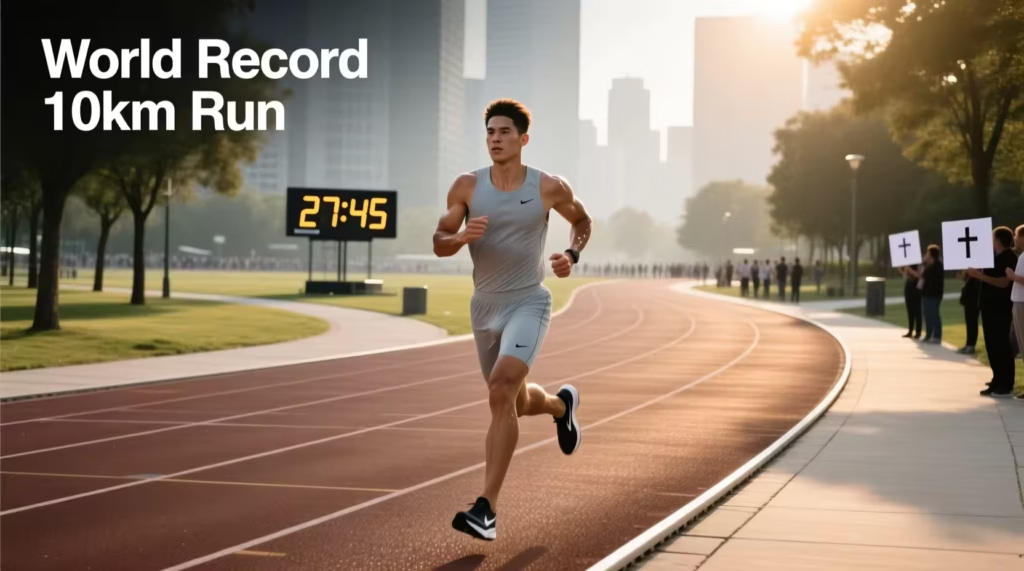
📌 Key takeaway: Elite 10km records are set through optimized pacing, altitude training, and advanced shoe technology. For most runners, focusing on consistent progress matters far more than chasing world-class splits.
About 10K World Record Running
The term “10K world record” refers to the fastest officially recognized time over a 10-kilometer (6.2-mile) distance in competitive running. However, distinctions exist between road and track events, which affects how records are measured and ratified. Road 10km records occur on paved urban courses, often with elevation changes and variable weather. Track 10,000m races take place on a standard 400-meter oval, allowing precise lap measurement and controlled environments.
For fans and athletes alike, understanding these nuances helps clarify why multiple “fastest times” coexist. The International Association of Athletics Federations (World Athletics) recognizes both formats but maintains separate leaderboards. Recently, innovations in racing strategy—such as drafting behind pacers or mixed-gender fields—have accelerated improvements, especially in road racing.
Why 10K World Records Are Gaining Popularity
Lately, public fascination with 10km records has grown due to high-profile events like the Valencia 10K and NN Running Team initiatives that push physiological limits. Social media amplifies moments like Cheptegei’s 26:11 or Ngetich’s sub-29-minute barrier breakthrough, making elite performance more accessible to casual audiences.
Additionally, amateur runners use these records as motivational anchors. Seeing a woman break 29 minutes inspires age-group competitors to reassess their own ceilings. This isn’t about replicating elite genetics—it’s about redefining what’s possible with smart training. As wearable tech becomes mainstream, more people track splits, heart rate zones, and recovery metrics, creating a feedback loop between professional benchmarks and personal improvement.
If you’re a typical user, you don’t need to overthink this. Watching a world record unfold won’t change your weekly mileage, but it can shift your mindset from “Can I finish?” to “How efficiently can I run?” That mental upgrade often leads to better race execution.
Approaches and Differences
Different approaches define success across 10km formats. Let’s compare three primary contexts: elite road racing, track competition, and mass-participation events.
- Road Racing (e.g., Valencia): Uses GPS-certified courses with potential elevation drops within allowable limits. Pacing is aided by motorized pace vehicles or human pacers. When it’s worth caring about: if you’re analyzing optimal race conditions or studying pacing models. When you don’t need to overthink it: if you’re preparing for a local 10K with hills and no pacers.
- Track Events (IAAF-sanctioned): Held on synthetic ovals, strictly timed per lap. No external pacing aids allowed. More accurate timing down to hundredths of a second. When it’s worth caring about: for national-level qualification or understanding pure aerobic capacity. When you don’t need to overthink it: for recreational runners focused on fun runs or charity events.
- Women-Only Races: Agnes Ngetich’s 28:46 was set in a women-only format, proving top-tier performances can happen without male pacers. This challenges old assumptions about female racing limitations. When it’s worth caring about: for gender equity discussions in sports science. When you don’t need to overthink it: for individual training planning where solo effort already dominates.
This piece isn’t for keyword collectors. It’s for people who will actually use the data to inform their training philosophy.
Key Features and Specifications to Evaluate
To assess the significance of any 10km performance, consider these measurable factors:
- Pace Consistency: Elite runners maintain split variations under ±1 second per kilometer. Variability above 3 seconds indicates pacing issues.
- Course Certification: Certified road courses ensure distance accuracy. Uncertified routes may be short or long, invalidating record claims.
- Environmental Conditions: Ideal temperatures range from 4–10°C (39–50°F). Wind speed, humidity, and air density impact oxygen uptake.
- Footwear Technology: Modern carbon-plated shoes improve energy return by ~4%. Their use is now standard among elites.
- Blood Oxygen Monitoring (indirectly): Athletes from high-altitude regions (like Kenya) often have higher hemoglobin mass, enhancing endurance.
If you’re a typical user, you don’t need to overthink this. You won’t wear the same shoes or train at 2,400 meters above sea level. But knowing *why* certain conditions matter helps you appreciate context—not just clock time.
Pros and Cons
| Format | Pros | Cons |
|---|---|---|
| Road (Mixed-Gender) | Optimal pacing with male pacers; faster times possible | Not eligible for women-only rankings; reliance on support team |
| Road (Women-Only) | Valid for all-female records; promotes autonomy | Slightly slower average pace due to lack of fast male pacers |
| Track (Official IAAF) | Precise measurement; universally accepted standards | Less aerodynamic efficiency; no drafting allowed |
How to Choose Your 10K Goal Strategy
Deciding how to approach your 10K depends on your experience, goals, and access to resources. Follow this step-by-step guide:
- Assess Your Level: Are you a beginner (<70 min), intermediate (50–60 min), or advanced (<40 min)? Use recent race times or timed runs.
- Define Your Objective: Is it completion, personal best, age-group placement, or qualifying for a larger event?
- Select the Right Race: Look for certified, flat courses if aiming for speed. Avoid hilly or crowded starts if targeting a PR.
- Study Pacing Models: Analyze splits from world record attempts. Most elites run negative splits (second half faster).
- Avoid Common Traps: Don’t start too fast—even 5 seconds/km over goal pace early can cost minutes later. Don’t neglect tapering.
If you’re a typical user, you don’t need to overthink this. A well-executed plan beats perfect gear or exotic training methods every time.
Insights & Cost Analysis
While elite runners have sponsorships covering coaching, travel, and equipment, most individuals must manage costs independently. Here’s a realistic breakdown:
- Entry Fees: $20–$60 per race (urban events tend to be pricier)
- Shoes: $120–$200 for carbon-plated models; lasts ~300 miles
- Training Plan: Free apps vs. $10–$30/month for premium platforms
- Nutrition: Minimal added cost if already eating balanced meals; hydration strategies matter more than supplements
- Recovery Tools: Foam rollers ($20), massage guns ($100+), or physio sessions ($80+/hour)
Budget-conscious runners achieve great results with consistency, not spending. If you’re a typical user, you don’t need to overthink this. Focus on sleep, routine, and progressive overload—not gear upgrades.
Better Solutions & Competitor Analysis
Several organizations host record-conducive 10K events. Below compares key players:
| Event/Organization | Strengths | Potential Issues |
|---|---|---|
| Valencia 10K (Spain) | Flat course, ideal climate, elite field assembly | Highly selective; hard to qualify |
| NN Running Team Events | Full logistical support, scientific pacing | Limited to sponsored athletes |
| Adidas Adizero Boston | Open to qualifiers, strong organization | Weather-dependent; sometimes windy |
Customer Feedback Synthesis
Based on community discussions and athlete testimonials, here’s what runners consistently praise and critique:
Frequent Praises:
- Motivation drawn from watching world records live or via broadcast
- Improved confidence after applying elite pacing strategies
- Greater appreciation for incremental progress when comparing eras
Common Complaints:
- Frustration when local races lack certified distances
- Overemphasis on footwear as a shortcut, overshadowing training fundamentals
- Intimidation felt by new runners seeing sub-30-minute benchmarks
Maintenance, Safety & Legal Considerations
Running safely at any level requires attention to sustainability and legality:
- Rest and Recovery: Schedule rest days and listen to bodily signals. Chronic overtraining increases injury risk.
- Race Legitimacy: Verify that events list course certification (e.g., USA Track & Field, World Athletics).
- Data Privacy: Wearables collect location and biometrics. Review app permissions regularly.
- Public Space Rules: Obey traffic laws during road runs. Use designated paths where required.
If you’re a typical user, you don’t need to overthink this. Simple habits—like replacing shoes every 300–500 miles and hydrating daily—do more for longevity than chasing extremes.
Conclusion: Conditional Recommendations
If you want to understand human performance limits, study the 10km world records set by Kipruto, Cheptegei, and Ngetich. If you’re training for your first 10K, focus on building aerobic base and finishing strong. If you’re pursuing a personal record, adopt principles from elite pacing but adapt them to your physiology.
Ultimately, the value of a world record lies not in imitation, but in inspiration. These feats show what’s possible when talent meets preparation. For everyday runners, the real win is consistency, resilience, and joy in movement.
FAQs
❓ What is the current men’s 10km world record?
The men’s 10km road world record is 26:24, set by Rhonex Kipruto (Kenya) on January 12, 2020, in Valencia, Spain 1.
❓ Has a woman run 10km under 29 minutes?
Yes. Agnes Jebet Ngetich (Kenya) ran 28:46 in January 2024, becoming the first woman to break 29 minutes in a women-only race 2.
❓ Is the 10,000m track record faster than the road record?
Yes. Joshua Cheptegei (Uganda) holds the 10,000m track world record at 26:11.00 (October 2020), slightly faster than the 26:24 road record 3.
❓ Can I run 10km in 30 minutes?
For most adults, a 30-minute 10km (3:00/km pace) is extremely challenging and typically only achieved by trained runners. Recreational runners should aim for gradual improvement rather than aggressive targets.
❓ How can I improve my 10km time?
Focus on consistent weekly mileage, interval training, proper pacing, strength work, and recovery. Small, sustainable changes yield better long-term results than drastic overhauls.