Is 2 Exercises Enough for Hamstrings? A Resistance Band Guide
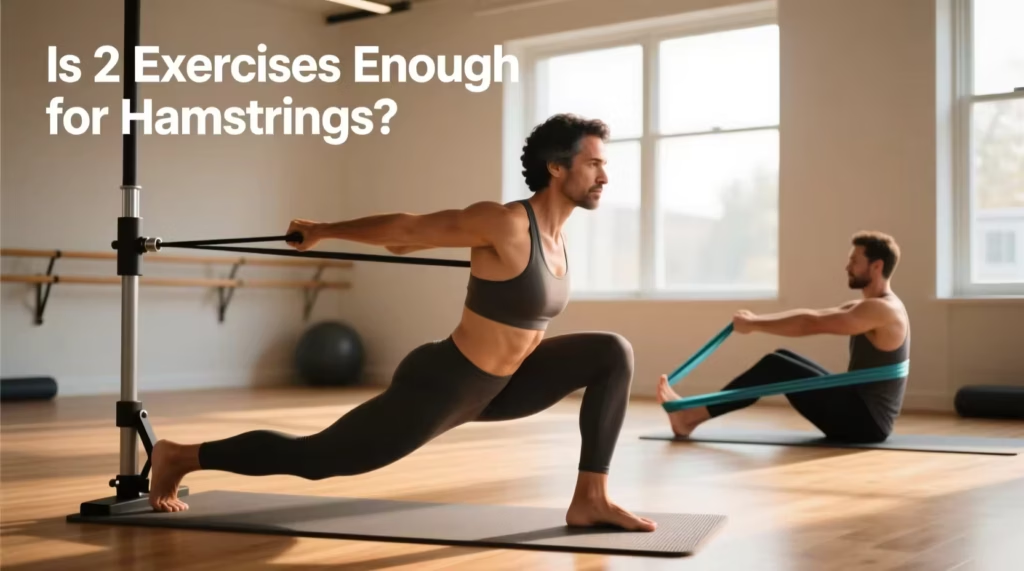
✅ Yes, two well-chosen hamstring exercises can be enough—especially for beginners or minimalist routines, as long as they cover both primary functions: hip extension and knee flexion 1. For example, pairing a resistance band Romanian deadlift (hip-focused) with a seated band hamstring curl (knee-focused) effectively targets all three hamstring muscles (biceps femoris, semitendinosus, semimembranosus). However, for optimal growth and balanced development, research suggests including 3–4 exercises and accumulating 10–20 weekly sets, with about 50–60% of volume from hip-dominant movements 9. Avoid relying solely on one movement pattern, as different exercises activate distinct muscle heads.
About Resistance Band Hamstring Workouts
🏋️♀️ A resistance band hamstring workout uses elastic bands to provide variable tension during exercises that strengthen the back of the thigh. These workouts focus on two biomechanical actions: hip extension (e.g., hinging at the waist) and knee flexion (e.g., bending the knee against resistance). Because hamstrings cross both the hip and knee joints, effective training requires targeting both motions 3.
Common setups include loop bands anchored around a stable object or door, or tube bands with handles. These tools allow users to perform compound and isolation movements at home, while traveling, or in space-limited environments. Typical exercises include band-assisted Romanian deadlifts, good mornings, seated curls, and Nordic curl variations.
Why Resistance Band Hamstring Training Is Gaining Popularity
🌐 The rise of home fitness and portable equipment has increased interest in resistance band-based leg training. Users seek cost-effective, low-impact alternatives to gym machines, especially for posterior chain development. Bands offer scalable resistance, making them suitable for all fitness levels—from rehabilitation-phase individuals to advanced lifters using layered bands for intensity.
⚡ Their lightweight design supports consistency in training frequency, which is crucial since hamstrings respond well to moderate-to-high volume over time. Additionally, bands provide constant tension throughout the range of motion, potentially enhancing muscle activation compared to free weights in certain movements like leg curls.
Approaches and Differences
📋 Two main philosophies exist when structuring a hamstring routine with resistance bands:
| Approach | Key Features | Pros | Cons |
|---|---|---|---|
| Minimalist (2-exercise) | One hip extension + one knee flexion move; 6–12 sets/week | Time-efficient, beginner-friendly, easy to master technique | Limited muscle fiber recruitment; less progression flexibility |
| Comprehensive (3–4 exercises) | Mix of RDLs, curls, Nordic variants; 12–20 sets/week | Balanced hypertrophy, reduced injury risk, better long-term gains | Requires more time, planning, and recovery |
While the minimalist method works for maintenance or early-stage strength building, the comprehensive approach aligns better with evidence-based hypertrophy guidelines 6. Choosing between them depends on goals, experience level, and available training time.
Key Features and Specifications to Evaluate
🔍 When designing an effective resistance band hamstring program, consider these measurable factors:
- Exercise selection diversity: Ensure coverage of both hip and knee joint actions.
- Weekly set volume: Aim for 10–20 total sets across sessions 9.
- Resistance level: Use heavier bands for hip-dominant moves (like RDLs), medium for knee-dominant curls.
- Progressive overload strategy: Track increases in band tension, reps, or time under tension.
- Movement control: Prioritize slow eccentrics and full range of motion over speed.
📊 To assess effectiveness, monitor improvements in strength (ability to use stronger bands), endurance (reps per set), and perceived muscle engagement after several weeks.
Pros and Cons
✨ Pros of Using Only 2 Exercises
- Efficiency: Quick sessions ideal for busy schedules.
- Simplicity: Easier to learn and maintain proper form.
- Beginner suitability: Reduces cognitive load and fatigue accumulation.
- Portability advantage: Full workout possible with just one or two bands 5.
❗ Cons of Limiting to 2 Exercises
- Incomplete stimulation: May under-target specific hamstring heads (e.g., semimembranosus).
- Plateau risk: Limited variation reduces mechanical stress diversity needed for ongoing adaptation.
- Imbalance potential: Over-relying on one plane may lead to muscular asymmetry over time.
- Suboptimal hypertrophy: Advanced lifters often require higher volume and exercise variety 4.
How to Choose the Right Hamstring Workout Approach
📌 Follow this step-by-step guide to decide whether 2 or more exercises suit your needs:
- Assess your experience level: Beginners can start with 2 exercises; intermediates should add variety after 6–8 weeks.
- Define your goal: Maintenance or general fitness? Two exercises may suffice. Hypertrophy or athletic performance? Add a third movement.
- Evaluate available time: If limited to 15–20 minutes, prioritize quality over quantity with 2 key lifts.
- Check recovery capacity: High-frequency training (2x/week) benefits from distributed volume across multiple exercises.
- Select complementary movements: Always pair a hip hinge (e.g., banded RDL) with a knee flexor (e.g., seated curl).
- Avoid this pitfall: Don’t perform two hip-dominant moves (e.g., RDL + good morning) without any knee flexion work—it neglects half the function.
Insights & Cost Analysis
💸 Resistance bands are among the most affordable strength training tools. A full set (light to heavy) typically costs $15–$30, replacing expensive gym machines or cable systems. Compared to barbells or weight benches, they require minimal storage and no installation.
📈 Long-term value comes from versatility: the same bands can train upper body, glutes, and legs. While there’s no recurring cost, users may need to replace bands every 1–2 years due to material degradation from repeated stretching.
Better Solutions & Competitor Analysis
🔧 While resistance bands are excellent for accessibility, other modalities offer different advantages:
| Solution | Best For | Potential Drawbacks | Budget Range |
|---|---|---|---|
| Resistance Bands | Home users, travelers, beginners | Harder to quantify load; shorter lifespan | $15–$30 |
| Dumbbells/Kettlebells | Progressive overload tracking | Space-consuming; higher initial cost | $50–$200+ |
| Gym Machines (Leg Curl) | Isolation precision, heavy loading | Requires gym membership; less functional | $40–$100/month |
For those committed to long-term hamstring development, combining band workouts with occasional machine or free-weight sessions may yield superior results through varied stimulus.
Customer Feedback Synthesis
📣 Based on aggregated user experiences:
- Frequent praise: “Easy to follow,” “great for home workouts,” “noticeable improvement in leg strength within 4 weeks.”
- Common complaints: “Bands snap after months of use,” “hard to progress consistently,” “difficult to anchor securely for Nordic curls.”
Many users appreciate the simplicity of a 2-exercise protocol but report hitting plateaus without adding complexity or external feedback (e.g., video form checks).
Maintenance, Safety & Legal Considerations
🧼 To ensure longevity and safety:
- Inspect bands before each use for cracks, tears, or fraying.
- Store away from direct sunlight and extreme temperatures.
- Anchor bands securely—avoid sharp edges that could cause snapping.
- Replace bands every 12–24 months depending on usage frequency.
🚫 Never stretch bands beyond 2.5x their resting length. Perform movements in controlled tempos to prevent recoil injuries. While no legal certifications are required for personal use, commercial trainers should verify product compliance with local consumer safety standards.
Conclusion
If you’re a beginner or prioritizing convenience, two resistance band hamstring exercises—one for hip extension and one for knee flexion—are sufficient to build foundational strength. However, if your goal is maximal hypertrophy, athletic performance, or balanced posterior chain development, incorporating 3–4 exercises and reaching 12–20 weekly sets will produce better long-term outcomes. Focus on progressive overload, proper technique, and consistent training frequency regardless of approach. Resistance bands remain a practical, scalable tool for hamstring development when used strategically.
FAQs
❓ Is 2 exercises enough for hamstrings?
Two exercises can be sufficient if they include one hip extension (e.g., banded RDL) and one knee flexion movement (e.g., seated curl), especially for beginners. Advanced users benefit from adding more variety and volume.
❓ Can you build hamstrings with resistance bands?
Yes, resistance bands can effectively build hamstring strength and size when used with proper exercise selection, progressive overload, and adequate volume (10–20 sets/week).
❓ How many times per week should I train hamstrings with bands?
Training hamstrings 2 times per week allows sufficient stimulus and recovery. Space sessions at least 48 hours apart for optimal adaptation.
❓ What resistance band should I use for hamstring exercises?
Use a heavy band for hip-dominant moves like RDLs and a medium band for knee-dominant curls. Adjust based on ability to complete target reps with good form.