Recently, Norwegian runner Jakob Ingebrigtsen set a new men’s 2-mile world record of 7:54.10 at the Meeting de Paris on June 9, 2023, breaking Daniel Komen’s 26-year-old mark of 7:58.61 1. This performance not only redefined what’s possible over two miles but also sparked renewed interest in mid-distance pacing strategies, physiological thresholds, and race execution. If you’re a typical recreational runner or coach, you don’t need to overthink this — elite times are outliers, not templates. However, understanding how such records are achieved can inform smarter training decisions, especially around aerobic development and race simulation.
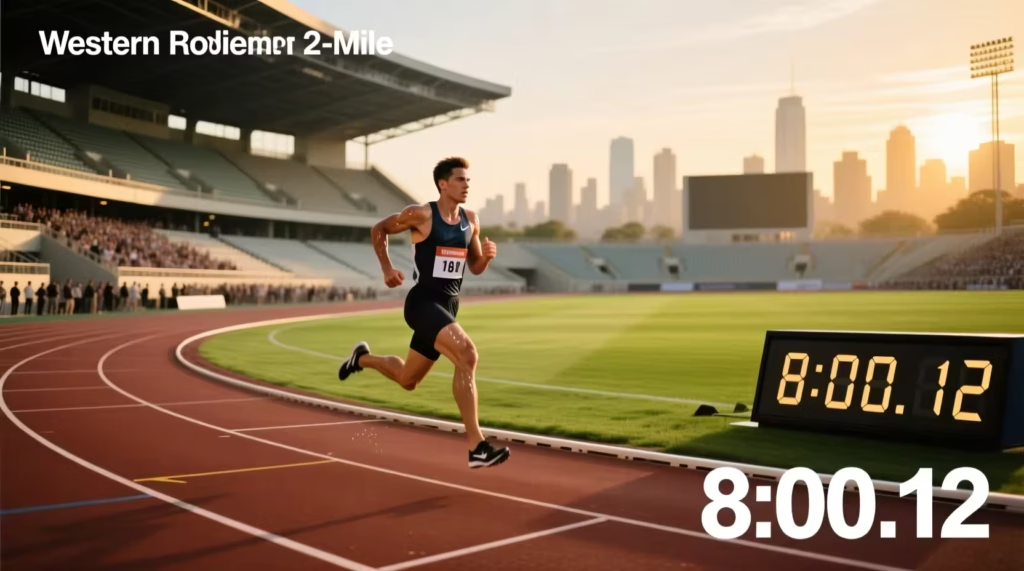
⚡ Key Insight: Ingebrigtsen became only the second man in history to break 8 minutes for 2 miles outdoors, joining Kenya’s Daniel Komen as the sole sub-8-minute performers 2. His final kilometer was run in 2:27.12 — an intensity few sustain even in isolated workouts.
This article explores the significance of the 2-mile world record from a practical running perspective. We’ll examine why this rare event matters beyond headlines, dissect common approaches to building speed-endurance, evaluate key performance indicators, and help you determine whether chasing faster short-distance doubles is worth your focus — or if other goals offer better returns.
About the 2-Mile Run 📌
The 2-mile run (approximately 3,218 meters) occupies a unique space between the mile and 5,000 meters. While rarely contested outside elite meets like the Diamond League, it demands a precise blend of aerobic capacity, lactate tolerance, and tactical awareness. Unlike longer distances where pacing errors can be corrected, the 2-mile punishes inefficiency early and compounds fatigue rapidly.
In competitive settings, the 2-mile often serves as a benchmark for middle-distance athletes preparing for 1500m or 3000m events. Collegiate programs in the U.S. occasionally feature it during indoor seasons, though outdoor appearances are sparse. For developmental runners, simulating 2-mile efforts helps bridge the gap between pure speed and sustained endurance.
Why the 2-Mile World Record Is Gaining Attention ✨
Over the past year, there’s been a subtle resurgence in interest around non-standard track distances — particularly the 2-mile — due to high-profile record attempts and broadcast visibility through platforms like NBC Sports and YouTube 3. The rarity of the event amplifies each performance, making records more memorable than incremental improvements in more common races.
Jakob Ingebrigtsen’s record shattered a long-standing barrier with dramatic flair: he ran negative splits, accelerating through the final laps while maintaining near-maximal effort. This contrasted sharply with older models of front-running dominance seen in Komen’s era. As a result, coaches and athletes are revisiting assumptions about optimal pacing and energy distribution.
If you’re a typical user, you don’t need to overthink this. Elite pacing strategies aren’t directly transferable to amateur racing. But the underlying principle — that controlled aggression beats reckless surges — applies universally.
Approaches and Differences ⚙️
Training for fast 2-mile performances generally falls into three categories:
- High-volume aerobic base + targeted speed work: Emphasizes weekly mileage (80+ miles for elites), long intervals (e.g., 10 x 800m), and tempo runs. Favored by East African traditions.
- Pace-specific neuromuscular conditioning: Focuses on repetition at goal pace (e.g., 3:57/km), often with short rest. Common among European-trained athletes like Ingebrigtsen.
- Race modeling via mixed-distance simulation: Combines mile and 3K pacing within single sessions (e.g., 6 x 1200m with variable speeds). Used in collegiate systems to develop versatility.
Each method has trade-offs:
| Approach | Advantages | Potential Drawbacks |
|---|---|---|
| High-Volume Aerobic Base | Builds robust cardiovascular foundation; reduces injury risk over time | Slower adaptation for speed; may lack neural specificity |
| Pace-Specific Conditioning | Sharpens race feel; improves metabolic efficiency at target pace | Higher strain per session; requires recovery management |
| Mixed-Distance Simulation | Develops pacing flexibility; mimics real-race unpredictability | Less focused on peak output; harder to measure progress |
When it’s worth caring about: If you compete regularly in 1500m–5000m events, choosing the right approach affects consistency and progression.
When you don’t need to overthink it: Recreational runners aiming for general fitness gain little from mimicking elite micro-training plans.
Key Features and Specifications to Evaluate 📊
To assess readiness for a fast 2-mile effort — whether testing yourself or guiding others — consider these measurable benchmarks:
- Mile personal best: A sub-4:10 mile suggests potential for sub-8:30 2-mile.
- VO₂ max estimate: Values above 65 mL/kg/min correlate with advanced aerobic power.
- Lactate threshold pace: Ability to sustain ~90% of VO₂ max pace for 20+ minutes indicates strong buffering capacity.
- Stride efficiency: Measured via contact time and flight ratio (wearables now provide this).
This piece isn’t for keyword collectors. It’s for people who will actually use the product.
Pros and Cons 📋
Benefits of targeting improved 2-mile times:
- Enhances overall speed-endurance synergy
- Provides clear metric for tracking aerobic development
- Useful proxy for predicting 5K performance
Drawbacks to consider:
- Neglecting recovery increases overuse injury risk
- Excessive focus on time may reduce enjoyment
- Limited applicability outside structured training environments
When it’s worth caring about: Competitive runners seeking measurable progress.
When you don’t need to overthink it: Casual joggers using running for stress relief or weight maintenance.
How to Choose Your Approach 🧭
Selecting a path depends on goals, experience level, and available support. Follow this decision guide:
- Define purpose: Are you training for competition, health, or curiosity?
- Assess current fitness: Can you comfortably run 3 miles at 8:00/mile pace? That’s a baseline.
- Evaluate schedule: Do you have 4–6 days/week for quality sessions plus recovery?
- Consider supervision: Working with a coach improves adherence and technique refinement.
- Avoid this mistake: Don’t increase volume and intensity simultaneously — one should stabilize before advancing the other.
If you’re a typical user, you don’t need to overthink this. Most runners benefit more from consistent moderate effort than from chasing narrow performance windows.
Insights & Cost Analysis 💡
Unlike equipment-heavy activities, improving 2-mile times primarily costs time and attention — not money. Still, some invest in tools:
- Fitness watches ($150–$500): Offer GPS, heart rate, and stride analytics.
- Coaching services ($80–$200/month): Provide personalized feedback and planning.
- Recovery aids (foam rollers, compression gear): $30–$150 total, mostly optional.
The highest return comes from structured programming and sleep consistency — both free. Spending heavily on gadgets without addressing fundamentals yields minimal gains.
Better Solutions & Competitor Analysis 🔍
For most adults, focusing on broader aerobic resilience offers greater long-term value than isolating 2-mile speed. Alternatives include:
| Solution | Best For | Potential Limitations |
|---|---|---|
| Consistent 5K Training | General fitness, race participation, community engagement | May lack intensity for advanced athletes |
| Cross-Training (Cycling, Swimming) | Injury prevention, joint preservation, cardiovascular balance | Running-specific adaptations reduced |
| Interval Walking Programs | Beginners, post-inactivity reentry, low-impact goals | Minimal speed development |
These options serve wider populations effectively. The 2-mile remains niche — valuable contextually, but not central to holistic fitness.
Customer Feedback Synthesis 🗣️
Among runners engaging with 2-mile challenges, recurring themes emerge:
Frequent praise:
- “It gave me a concrete goal beyond just ‘run farther.’”
- “Tracking my splits helped me understand pacing better.”
Common frustrations:
- “Too hard to find official races — ended up self-timing.”
- “Felt discouraged when I couldn’t come close to elite splits.”
Managing expectations is crucial. Comparing oneself to world-record holders sets unrealistic standards.
Maintenance, Safety & Legal Considerations 🛡️
Running carries inherent risks, including musculoskeletal strain and environmental exposure. To stay safe:
- Progress gradually: Increase weekly distance by no more than 10%.
- Wear appropriate footwear suited to surface and gait.
- Hydrate before, during, and after prolonged efforts.
- Be aware of local regulations regarding public pathway usage.
No formal certification governs amateur 2-mile attempts. Self-timed efforts are acceptable for personal tracking, provided they follow consistent conditions (e.g., flat course, accurate measurement).
Conclusion: Who Should Care — and Why 🎯
If you need a measurable challenge to structure your training, targeting a faster 2-mile time can be motivating. If you’re already competitive in middle-distance events, studying elite performances like Ingebrigtsen’s adds useful context.
But if your aim is general well-being, longevity, or mental clarity, prioritize consistency, enjoyment, and sustainable habits over narrow metrics. The world record stands as inspiration — not obligation.
If you’re a typical user, you don’t need to overthink this. Focus on showing up, moving regularly, and listening to your body. Everything else follows.
Frequently Asked Questions ❓
What is the fastest 2-mile ever recorded?
The men’s world record for the 2-mile run is 7:54.10, set by Norway’s Jakob Ingebrigtsen on June 9, 2023, at the Meeting de Paris 1.
How fast can a human realistically run 2 miles?
For elite male runners, sub-8 minutes is achievable. For recreational athletes, times between 10:00 and 14:00 are common depending on fitness level. Women’s elite times hover around 8:50–9:20.
What is the army 2-mile run standard?
U.S. Army requirements vary by age and gender, but passing typically requires completing the 2-mile run in under 15:36 for men and 18:54 for women (ages 17–21) 4.
Is the 2-mile run still relevant today?
While not an Olympic event, the 2-mile remains a valuable training tool and occasional showcase in elite meets. Its physiological demands make it useful for assessing middle-distance readiness.
Can I improve my 2-mile time without a coach?
Yes. With consistent training, proper pacing practice, and adequate recovery, most runners can improve. Free resources like interval calculators and running apps support self-guided progress.