Lately, sprinting has seen renewed interest—not just among elite athletes but also fitness enthusiasts aiming to boost speed, power, and overall athletic performance. If you’re looking to improve your 100m run time, the most effective approach combines proper technique, consistent strength training, and race-specific conditioning. Over the past year, increased visibility of sprint events like Oblique Seville’s 9.77s win at the 2025 World Championships has sparked broader curiosity about what it takes to sprint faster 1. For most people, chasing sub-10 seconds isn’t realistic—but improving by even 0.5 seconds is achievable with focused effort. If you’re a typical user, you don’t need to overthink this: prioritize form drills, explosive strength work, and short interval sprints three times per week.
About the 100m Run
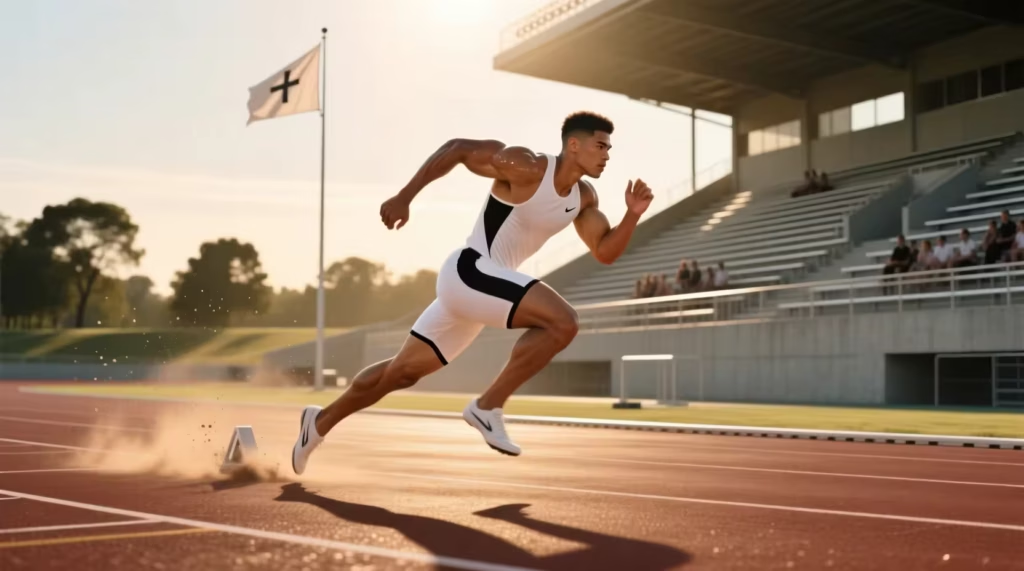
The 100-meter sprint, often called the fastest race in track and field 🏃♂️, is a full-effort burst of speed over a straight 100m course. It tests raw acceleration, neuromuscular coordination, and maximum velocity capability. Unlike endurance runs, the 100m relies almost entirely on anaerobic energy systems, meaning oxygen delivery plays little role during the actual race.
This event is common in high school and college athletics, CrossFit workouts (like “100m Run + Kettlebell Swings”) 2, and fitness assessments. While elite male sprinters average around 10 seconds and women around 11 seconds, recreational runners typically clock between 14–18 seconds. The current world record—Usain Bolt’s 9.58 seconds from 2009—remains a benchmark of human speed potential 3.

Why the 100m Run Is Gaining Popularity
Recently, short sprints have gained traction beyond traditional track circles. High-intensity interval training (HIIT) programs frequently include 100m dashes as a tool for fat loss, cardiovascular resilience, and power development. Coaches now recognize that brief maximal efforts can enhance metabolic flexibility more efficiently than long jogs.
Additionally, viral videos of elite races—such as Seville’s 2025 victory—have made sprinting visually compelling and aspirational. Social media challenges featuring amateur 100m attempts further democratize access to sprint culture. People are realizing that speed isn’t just for elites—it’s a trainable skill linked to agility, reaction time, and functional fitness.
If you’re a typical user, you don’t need to overthink this: incorporating occasional 100m sprints into your routine improves fast-twitch muscle recruitment and boosts confidence in physical capability.
Approaches and Differences
There are several ways to train for the 100m, each suited to different experience levels and goals:
- ⚡Technique-Focused Training: Emphasizes sprint mechanics—posture, arm drive, foot strike, and stride length. Ideal for beginners correcting inefficient movement patterns.
- 🏋️♀️Strength & Power Development: Involves plyometrics, weightlifting (e.g., squats, deadlifts), and resisted sprints. Best for intermediate athletes plateauing despite good form.
- ⏱️Interval-Based Speed Work: Includes repetitions of 60m, 80m, or 100m at near-maximal effort with full recovery. Used by competitive sprinters to build race-specific endurance.
- 🧘♂️Mind-Muscle Connection Drills: Less common but growing—uses visualization, breath control, and cue-based running to refine timing and reduce neural hesitation.
When it’s worth caring about: choosing an approach depends on your current fitness baseline and whether you’re preparing for competition or general improvement.
When you don’t need to overthink it: if you’re new to sprinting, start with technique and light intervals before adding complex strength routines.
Key Features and Specifications to Evaluate
To assess progress and guide training, focus on measurable indicators:
- Start Reaction Time: Measured electronically in elite settings; informally via video review for amateurs.
- Acceleration Phase (0–30m): Critical for early lead. Evaluated through split times.
- Top-End Speed (60–80m): Where elite differences emerge. Requires optimal stride frequency and force application.
- Speed Endurance (80–100m): Ability to maintain velocity without deceleration.
- Stride Length vs. Stride Rate Balance: Longer strides aren’t always better—coordination matters more.
This piece isn’t for keyword collectors. It’s for people who will actually use the product.
If you’re a typical user, you don’t need to overthink this: tracking only your total 100m time is sufficient initially. As you improve, break it into segments using a stopwatch or app.
Pros and Cons
Pros:
- Builds explosive power applicable to many sports
- Short duration makes it time-efficient
- Improves insulin sensitivity and body composition
- Enhances nervous system responsiveness
Cons:
- High injury risk if done improperly or too frequently
- Requires adequate warm-up and recovery
- Not suitable for individuals with joint instability or mobility limitations
- Progress plateaus quickly without structured programming
When it’s worth caring about: balancing intensity with recovery prevents overuse injuries while maximizing adaptation.
When you don’t need to overthink it: for general fitness, one quality sprint session per week is enough to see benefits.

How to Choose a 100m Run Training Plan
Follow this step-by-step checklist to select the right strategy:
- Assess Your Current Level: Can you sprint 100m safely without pain? Record your baseline time.
- Define Your Goal: Are you training for competition, fitness testing, or personal challenge?
- Pick a Primary Focus: Beginners → technique; intermediates → strength + speed; advanced → race modeling.
- Schedule Realistic Sessions: 1–3 sessions/week with at least 48 hours between intense sprints.
- Include Warm-Up & Cool-Down: Dynamic stretches, drills (A-skips, bounding), and foam rolling post-run.
- Avoid Common Mistakes: Skipping rest days, neglecting core stability, or increasing volume too fast.
If you’re a typical user, you don’t need to overthink this: begin with two weekly sessions—one technique day and one interval day—and adjust after four weeks based on results and recovery.
Insights & Cost Analysis
Training for the 100m doesn’t require expensive equipment. Most improvements come from consistency, not gear. However, some tools may help:
| Tool | Benefit | Potential Issue | Budget |
|---|---|---|---|
| Stopwatch or Timer App | Track splits and monitor progress | Manual timing less accurate | $0–$5 |
| Resistance Bands | Improve starting drive mechanics | Limited load progression | $10–$25 |
| Weighted Vest (light) | Add overload to accelerations | Risk of altered mechanics if too heavy | $40–$80 |
| Sprint Track Access | Safe, flat surface with measured distance | May require facility membership | $0–$100/month |
When it’s worth caring about: investing in coaching or video analysis pays off if you’re aiming for competition.
When you don’t need to overthink it: for casual improvement, free apps and public tracks are all you need.
Better Solutions & Competitor Analysis
While pure 100m sprinting is unmatched for developing top speed, other modalities offer complementary benefits:
| Alternative | Advantage Over 100m | Limitation | Better For |
|---|---|---|---|
| 50m Sprints | Lower fatigue, higher quality reps | Less race-specific endurance | Beginners, rehab phases |
| Cycle Sprints | Reduced joint impact | Different motor pattern | Injury-prone users |
| Hill Sprints (20–30m) | Greater force production, safer loading | Harder to measure exact distance | Strength-phase training |
| Resisted Sled Pushes | Improved start mechanics, low injury risk | Does not replicate full sprint cycle | Off-season prep |
If you’re a typical user, you don’t need to overthink this: the 100m remains the gold standard for measuring sprint ability. Alternatives should supplement, not replace, it when appropriate.
Customer Feedback Synthesis
Analysis of online discussions reveals recurring themes:
- Frequent Praise: Users report feeling stronger, faster, and more energized after integrating sprint work. Many appreciate the mental toughness built through maximal effort.
- Common Complaints: Some note soreness, difficulty recovering, or frustration with slow progress. Others mention lack of access to proper tracks or timing tools.
- Unexpected Benefit: Improved coordination in daily movements and better posture during standing activities.
When it’s worth caring about: listening to peer experiences helps set realistic expectations.
When you don’t need to overthink it: individual variation is normal—your timeline won’t match everyone else’s.
Maintenance, Safety & Legal Considerations
Safety is paramount in sprint training. Always:
- Warm up thoroughly with dynamic movements
- Avoid sprinting on hard concrete surfaces
- Ensure footwear provides grip and heel support
- Allow 48–72 hours between high-intensity sprint sessions
- Stop immediately if sharp pain occurs
No legal restrictions exist for sprinting in public spaces, but check local regulations for track usage (some facilities require reservations or fees). This piece isn’t for keyword collectors. It’s for people who will actually use the product.
Conclusion
If you need to improve your speed, power, or athletic performance, structured 100m sprint training is highly effective. For competitive athletes, combine technical drills with strength and race modeling. For general fitness enthusiasts, one well-executed sprint session per week yields noticeable gains. If you’re a typical user, you don’t need to overthink this: start small, stay consistent, and let data—not hype—guide your progress.
FAQs
What is a good 100m time for a beginner? For untrained adults, a time between 14 and 18 seconds is typical. With consistent training, most can reduce this by 1–2 seconds within 8–12 weeks. How often should I train the 100m sprint? Once or twice per week is sufficient. Maximal sprints require full recovery—never perform them on consecutive days. Do I need special shoes for 100m sprinting? Sprint spikes offer better traction and efficiency, but they’re not required for recreational training. A stable running shoe with firm cushioning works well initially. Can I train 100m sprints at home? Yes, if you have access to a safe, flat, measured space (e.g., school track, park path). Use cones or landmarks to mark 100m accurately. Will sprinting help me lose fat? Yes—high-intensity sprinting increases excess post-exercise oxygen consumption (EPOC), boosting calorie burn for hours after exercise. Pair it with balanced nutrition for best results.