How to Do a 1-Minute Plank Every Day: A Complete Guide
Yes, doing a 1-minute plank every day can improve your core strength, posture, and functional stability—especially if performed with correct form. This simple isometric exercise activates multiple muscle groups including the abdominals, obliques, transverse abdominis, glutes, shoulders, and spinal erectors 12. While holding a plank for longer than 1 minute isn’t necessarily better—and may even increase risk of poor form or strain—daily consistency with a 1-minute hold builds muscular endurance and body awareness over time 3. For most people, this duration strikes a balance between effectiveness and sustainability, especially when integrated into a broader movement routine.
About the 1-Minute Daily Plank
The 1-minute daily plank is a structured fitness habit where an individual performs a single front plank for 60 seconds each day. The plank itself is an isometric bodyweight exercise that requires maintaining a static position while engaging the entire core and stabilizing muscles across the body. Unlike dynamic exercises such as crunches or sit-ups, the plank emphasizes sustained tension and alignment rather than repetitive motion.
This practice has become popular due to its low barrier to entry—no equipment, minimal space, and short time commitment are required. It’s often used as part of morning routines, warm-ups before workouts, or evening cooldowns. Common variations include forearm planks, high planks (on hands), side planks, and knee planks for modified support.
Typical goals associated with the 1-minute daily plank include building foundational core strength, improving postural control, enhancing body awareness, and developing mental discipline through consistent effort.
Why the 1-Minute Daily Plank Is Gaining Popularity
⭐ Mental resilience meets physical training: In a culture increasingly focused on holistic wellness, the 1-minute plank represents more than just a physical challenge—it’s a daily act of self-discipline. Many users report that successfully completing the hold fosters a sense of accomplishment, which supports broader lifestyle changes.
⏱️ Time efficiency: With only 60 seconds required per day, it fits easily into busy schedules. Compared to longer workouts, this micro-habit feels manageable and sustainable, reducing dropout rates common in more intensive programs.
🏠 Accessibility: No gym membership, equipment, or special clothing is needed. People can perform the plank at home, in hotel rooms, or during work breaks, making it highly adaptable across lifestyles.
📈 Measurable progress: The ability to hold a full minute improves gradually for beginners. Tracking improvements—from 20 seconds to 60—provides tangible feedback, reinforcing motivation and adherence.
Approaches and Differences
Different experts recommend varying approaches to plank duration and frequency. Understanding these methods helps you choose one aligned with your goals and physical readiness.
| Approach | Key Features | Advantages | Potential Issues |
|---|---|---|---|
| 1-Minute Daily Hold | One continuous 60-second plank daily | Simple to track; builds endurance; widely recommended benchmark | Risk of form breakdown in later seconds; not ideal for absolute beginners |
| Interval Planking (Short Bursts) | Multiple sets of 10–20 seconds with rest | Reduces fatigue; maintains better form; supported by spine biomechanics research | May feel less satisfying due to shorter holds; requires timing |
| Progressive Overload | Start with 20 sec, add 5–10 sec weekly until reaching 1 min+ | Adaptable for all levels; reduces injury risk; promotes steady gains | Slower visible progress; requires tracking |
| Plank Challenge (30-Day Programs) | Structured daily increases in hold time | Clear roadmap; community support available; gamified experience | Some plans exceed safe durations too quickly; may encourage poor form |
Key Features and Specifications to Evaluate
To assess whether a 1-minute daily plank suits your needs, consider the following measurable criteria:
- ✅ Form Quality: Can you maintain a straight line from head to heels without sagging hips or raised buttocks?
- ✅ Muscle Engagement: Are your core, glutes, and shoulders actively contracted throughout?
- ✅ Breathing Pattern: Are you breathing steadily instead of holding your breath?
- ✅ Hold Duration: Is 60 seconds achievable without compromising technique?
- ✅ Frequency Consistency: How many days per week can you realistically commit?
- ✅ Progression Plan: Do you have a method to advance (e.g., longer holds, harder variations)?
A well-executed plank should feel challenging but controlled. If pain (not discomfort) arises, stop immediately and reassess form or intensity.
Pros and Cons
Pros ✅
- Improves Core Stability: Enhances neuromuscular control of deep abdominal muscles critical for balance and movement 4.
- Supports Posture: Strengthens postural muscles, helping reduce slouching during sitting or standing.
- Functional Carryover: Benefits everyday movements like lifting, bending, and twisting.
- Mental Focus: Requires concentration and breath control, supporting mindfulness-in-motion.
- No Equipment Needed: Accessible to nearly everyone regardless of fitness level or environment.
Cons ❗
- Limited Muscle Hypertrophy: Does not significantly build large, visible abs without additional resistance training.
- Risk of Poor Form: Extended holds may lead to lower back arching or shoulder strain if technique falters.
- Not a Full Workout: Should be complemented with cardio, flexibility, and other strength exercises.
- Plateau Risk: Holding the same position daily without progression may stop yielding benefits after several weeks.
How to Choose the Right Planking Strategy
Follow this step-by-step guide to select the best approach for your situation:
- Assess Your Current Ability: Try holding a plank now. If you can’t manage 20 seconds with good form, start with shorter holds.
- Define Your Goal: Is it core endurance? Posture improvement? Mental challenge? Match your method accordingly.
- Select Based on Experience Level:
- Beginner: Use interval holds (3 x 20 seconds) or progressive buildup.
- Intermediate: Aim for 1-minute daily with attention to form.
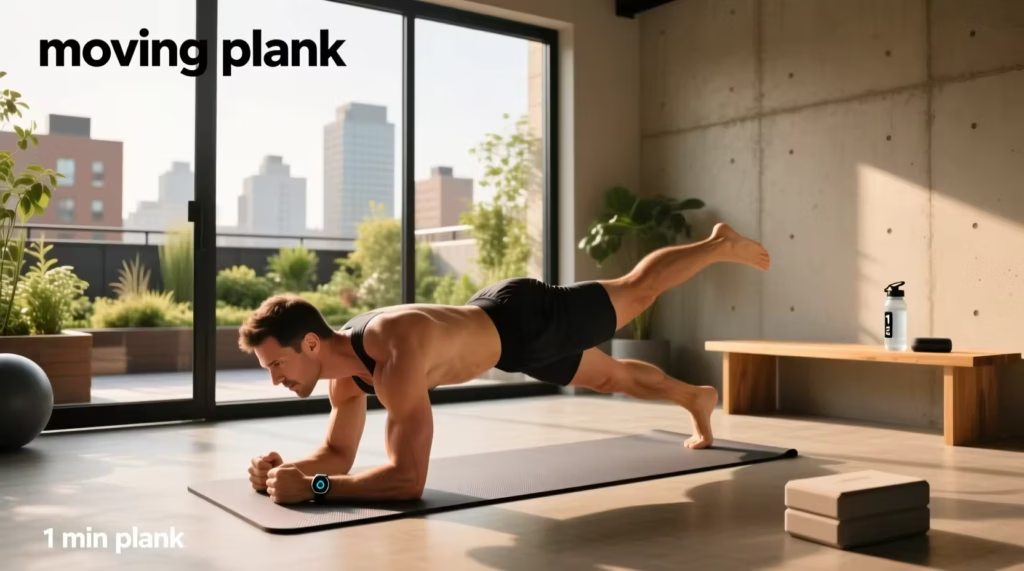
- Advanced: Incorporate variations (side plank, weighted plank, moving plank).
- Plan for Progression: After 2–3 weeks, increase duration, add sets, or try harder versions.
- Avoid These Pitfalls:
- ❌ Sacrificing form for time
- ❌ Holding breath during the hold
- ❌ Doing planks exclusively without other movement types
- ❌ Ignoring pain or numbness
Insights & Cost Analysis
The 1-minute daily plank costs nothing financially. It requires no subscription, gear, or facility access. However, there is an opportunity cost in time and consistency.
Compared to alternatives like Pilates classes ($15–$30/session) or core-focused gym machines (membership $40+/month), the plank offers exceptional value as a foundational tool. That said, it should not replace comprehensive training long-term. Think of it as a baseline habit—like brushing your teeth—that supports larger fitness goals.
For those seeking guidance, free video tutorials and apps exist. Paid platforms (e.g., Peloton, Fitbit Premium) may offer structured challenges, but they are not necessary for success.
Better Solutions & Competitor Analysis
While the 1-minute plank is effective, combining it with other core exercises yields superior results. Below is a comparison of common core-building strategies:
| Solution | Best For | Potential Limitations |
|---|---|---|
| 1-Minute Daily Plank | Core endurance, posture, habit formation | Limited strength/mass gains; form-sensitive |
| Dynamic Core Circuit (e.g., bird-dog, dead bug, leg raises) | Muscle coordination, spinal health, functional strength | Requires learning multiple moves |
| Pilates (Mat or Reformer) | Deep core activation, flexibility, mind-body connection | Costly; access-dependent |
| Resistance Training (e.g., cable chops, ab wheel) | Muscle growth, power transfer, athletic performance | Needs equipment; steeper learning curve |
The plank works best when integrated into a diverse routine rather than used in isolation.
Customer Feedback Synthesis
Analysis of user experiences from fitness communities and challenge participants reveals recurring themes:
Frequent Praises ✨
- “I noticed my posture improved within two weeks. I stand taller without thinking.”
- “It’s the one exercise I never skip because it takes less than 2 minutes.”
- “My core feels tighter, and I’m stronger during other workouts like squats and push-ups.”
- “The mental challenge taught me to stay calm under physical stress.”
Common Complaints ❌
- “My wrists hurt, so I switched to forearm planks.”
- “After a month, I stopped seeing progress—felt stuck.”
- “I didn’t realize my form was off until I filmed myself.”
- “It gets boring doing the same thing every day.”
Maintenance, Safety & Legal Considerations
Maintaining the 1-minute plank habit involves regular self-assessment:
- 📹 Record yourself occasionally to check body alignment.
- 🔄 Rotate in variations (side plank, reverse plank) to prevent overuse patterns.
- 🧘 Pair with stretching or breathing exercises to enhance recovery.
Safety tips:
- Stop immediately if sharp pain occurs.
- Avoid locking elbows or shrugging shoulders.
- Modify on knees if standard form causes strain.
No legal restrictions apply to performing planks. Always consult public space rules if exercising outdoors or in shared facilities.
Conclusion
If you’re looking to build foundational core strength, improve postural awareness, and develop daily discipline with minimal time investment, doing a 1-minute plank every day can be a valuable addition to your routine. The key lies in consistent execution with proper form—not maximizing hold time at the expense of technique. For beginners, starting with shorter intervals and progressing gradually is safer and more effective. Advanced individuals should use the plank as one component of a broader strength and mobility strategy. When done correctly, this small daily effort contributes meaningfully to overall physical resilience and mindful movement habits.
FAQs
Does holding a 1-minute plank every day do anything?
Yes, it can improve core endurance, posture, and body awareness over time, especially when performed with correct form. It’s most effective as part of a balanced movement routine.
Is a 1-minute plank good for beginners?
It can be, but many beginners should start with shorter holds (20–30 seconds) and build up gradually to avoid form breakdown and fatigue.
What happens if I do a 1-minute plank every day for 30 days?
You may notice improved core strength, better posture, and increased mental focus. Physical changes like muscle definition typically require diet and additional training.
Are there better alternatives to the standard plank?
Yes—exercises like dead bugs, bird-dogs, and cable rotations provide dynamic core engagement and may be more functional for some individuals.
Should I do planks every day?
Daily planks are generally safe if form is maintained and no pain occurs. However, alternating with other core exercises can prevent plateaus and promote balanced development.