Marine biologists are reporting a pattern of strange interventions: humpback whales are muscling into orca attacks, shielding prey that is often not their own, and forcing researchers to rethink how power and protection work in the ocean.
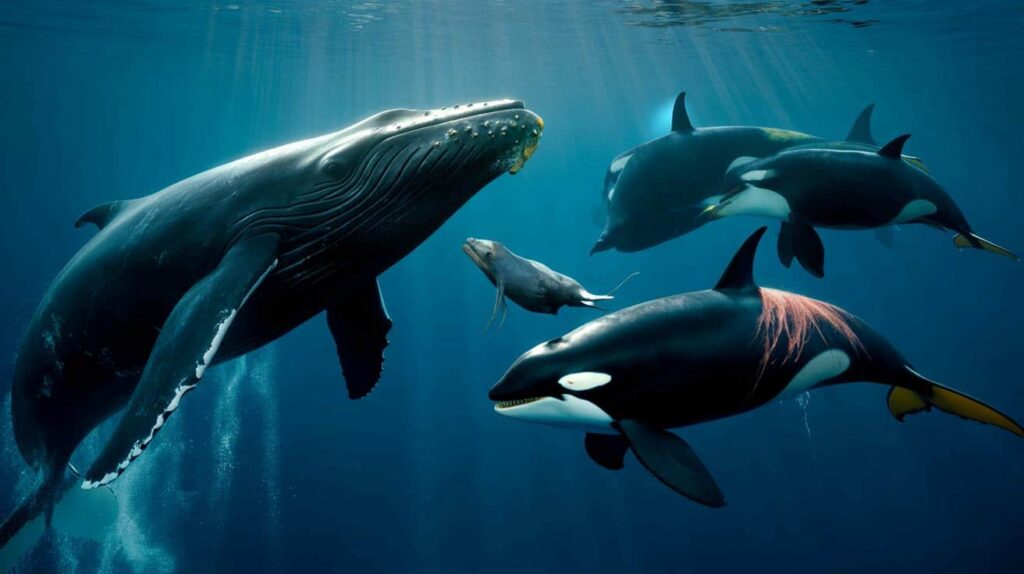
When humpback muscle stands up to killer whales
Orcas sit high on the marine food chain. They hunt in coordinated packs, move fast, and carry a mouthful of sharp teeth. Few animals willingly cross their path. Humpback whales are becoming a striking exception.
An adult humpback can measure more than 15 metres and weigh well over 30 tonnes. Add those huge, five‑metre pectoral fins, dotted with bony bumps and sometimes razor‑edged barnacles, and the animal starts to look less like a gentle giant and more like a swimming battering ram.

Researchers monitoring confrontations report that humpbacks do not simply keep their distance. They swing those fins like clubs. They slam their tails. They line up their bodies between orcas and the target under attack, whether that target is a humpback calf, a grey whale, a seal or a sea lion.
Field teams have watched humpbacks rush at hunting orcas, striking with tails and fins hard enough to leave visible wounds and break off attacks.
Marine Mammal Science has described some of these scenes as a classic case of “mobbing”. In many wildlife species, mobbing happens when animals gang up on a predator, harassing it until the danger passes. Crows do it to hawks. Meerkats do it to snakes. Now, on a different scale entirely, humpbacks appear to be doing it to orcas.
Why brute force beats running away
Part of the story is simple physics. Sleeker whales such as fin or minke whales can outrun orcas when attacked. Humpbacks cannot. Their build is powerful but not streamlined, so speed is not their best defence.
Instead, humpbacks rely on agility and force at close range. Those long fins act like rudders, letting them pivot sharply in the water. A single tail slap from a 30‑tonne animal carries serious risk for any predator nearby.
Robert Pitman, a long‑time cetacean researcher with the US National Oceanic and Atmospheric Administration (NOAA), has documented multiple cases where humpbacks opted to stand their ground rather than flee, even when outnumbered by orcas.
Rather than sprint away, humpbacks often turn toward the threat, turning their bulk and surprising manoeuvrability into a defensive shield.
Ripple effects across the marine food web
Interfering with a hunt sounds heroic, but it also rewrites the balance between predator and prey, at least in the short term. When scientists pulled together dozens of reports of these encounters, one detail stood out: in about 9 out of 10 documented cases, the orcas were not trying to kill a humpback at all.
They were targeting other animals instead:
- seals hauled out on ice or swimming near the surface
- sea lions scattered along coastal waters
- small whales and dolphins
- calves of other baleen whale species
When humpbacks charge in, those original targets often gain a few precious seconds. That window can mean escape, especially for agile animals like dolphins or seals that need only a small gap to vanish underwater or scramble onto ice.
For orca pods, repeated failures like this can be costly. Hunts burn vast amounts of energy. If humpback interventions become common in certain feeding areas, orcas may start avoiding those hot spots, shift to different prey, or change their hunting tactics.
By breaking up attacks, humpbacks may slightly reduce orca hunting success, which in turn affects how energy and nutrients move through the ocean’s food chains.
Marine biologist Alisa Schulman‑Janiger, who runs the California Killer Whale Project, has recorded cases where humpbacks left dense patches of krill — their favourite food — to steam toward an orca hunt. Skipping a meal in the open ocean is no small choice, especially for animals that need to pack on energy reserves for migration and breeding.
What could drive such risky behaviour?
Scientists are cautious about reading motives into animal actions, but a few plausible explanations keep coming up.
Defending calves, even at a distance
Orcas frequently target humpback calves. A successful attack can mean the loss of a mother’s entire reproductive effort for several years. Under that kind of pressure, strong defensive responses are expected to evolve.

Humpbacks appear to react quickly to the distinctive calls and underwater noise made by orcas on the hunt. Pitman and Schulman‑Janiger have noted that these whales sometimes charge toward orca attack sounds before they can see what is being chased.
One idea is that humpbacks respond broadly to “orca attack noise” as a threat to calves, even when the victim is a different species.
In that scenario, the behaviour began as calf protection but spills over into something that looks like cross‑species rescue. The whales are not necessarily choosing to help seals; they are reacting to a generic danger signal.
Family ties, payback and possible empathy
A second line of thinking looks at social relationships. Humpbacks tend to return to the same breeding and feeding grounds year after year. That makes it likely that many individuals in an area are at least distant relatives.
Defending any young whale nearby, not just your own offspring, can still help spread shared genes. Over generations, such behaviour might be favoured by natural selection, even if it occasionally benefits unrelated species as a side effect.
Some researchers also raise the idea of reciprocity and even rudimentary empathy. These whales have large, complex brains and show flexible behaviour: coordinated feeding tactics, long‑range communication, and cultural traditions in their songs.
Once an animal is capable of planning and recognising distress in others, lines between strict self‑interest and broader helping behaviour can blur.
There are reports of humpbacks apparently escorting injured animals or hovering near distressed whales of other species, though these observations remain scattered and hard to interpret scientifically.
What “mobbing” and “altruism” mean in animal behaviour
Two behavioural terms often appear in discussions of humpback–orca clashes: mobbing and altruism. They sound simple, but in biology they have precise meanings.
Mobbing refers to small or mid‑sized animals confronting a predator in a group. The aim is to drive the predator away, not to kill it. The risk is shared among many attackers, which lowers the danger for each individual.
Altruism describes behaviour that seems to reduce an animal’s own chances of survival or reproduction while increasing those of another. In practice, biologists typically link such behaviour to benefits that show up elsewhere — like helping relatives that carry similar genes.
| Behaviour | Typical benefit | Risk to the animal |
|---|---|---|
| Mobbing a predator | Reduces future threat to group or offspring | Injury during attack, energy loss |
| Helping unrelated prey | Possible long‑term social or ecological gains | Immediate energy cost, potential for harm |
Humpback interventions tick several boxes from both columns, which is why they are sparking lively debate among behaviourists and evolutionary biologists.
What future research might reveal
Scientists are now trying to move from scattered anecdotes to robust data. That means long‑term monitoring of humpbacks and orcas in shared hotspots — off Alaska, along the Pacific coast of North America, around Antarctica, and in parts of the Southern Ocean.
Teams are using drones, high‑resolution cameras and underwater microphones to capture full sequences of hunts and interventions. By tagging individual whales with temporary suction‑cup devices, researchers can track heart rate, movement and sound exposure during these events.
Computer simulations are also starting to model what would happen if humpbacks repeatedly disrupt a certain fraction of orca hunts in a region. Early models suggest even a modest interference rate could change where orcas choose to hunt and how many calves of other species survive their first year.
For people watching from whale‑watching boats or coastal cliffs, a humpback charging into an orca hunt can look almost cinematic, a clean story of heroes and villains. Reality is more tangled. These confrontations weave together survival instincts, family ties, learned behaviour and perhaps, at the edges, something that looks uncannily like compassion from the ocean’s gentle bruisers.