Now a mix of genetics, chemistry and old-fashioned archive work has overturned what curators, historians and visitors thought they knew about one of Germany’s most notorious highwaymen, exposing a two-hundred-year error in a single, clear forensic verdict.
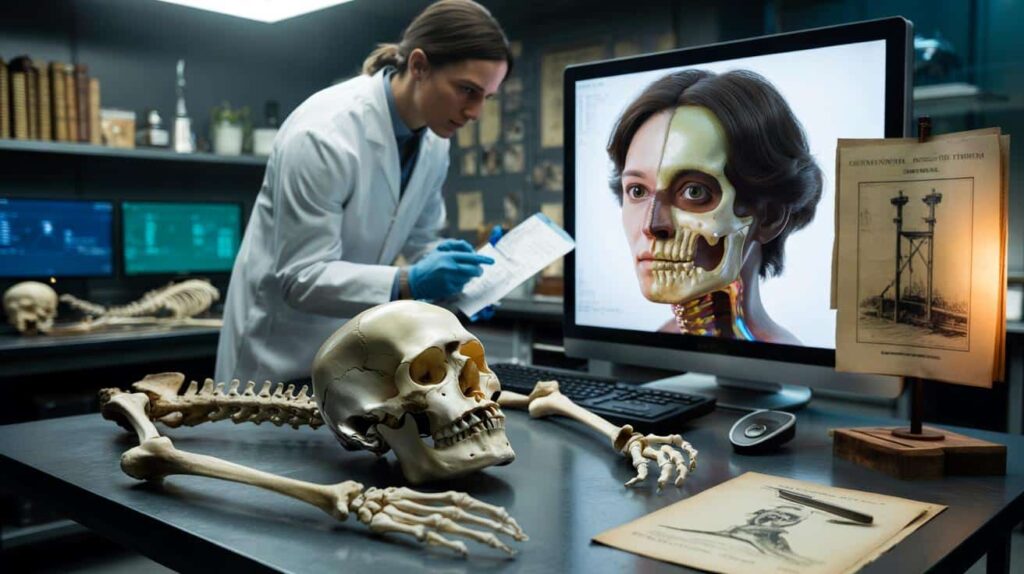
A romantic outlaw, a public execution, and a missing body
The story begins on 21 November 1803 in the city of Mainz. Johannes Bückler, better known as Schinderhannes, was led to the guillotine alongside fellow outlaw Christian Reinhard, nicknamed “Schwarzer Jonas”. Around 30,000 people reportedly watched the execution.
Both men had become infamous along the Rhine for robberies, extortion and killings. Their exploits fed early 19th‑century pamphlets and later inspired romanticised tales of the “noble” bandit resisting authority.

Once the spectacle ended, doctors stepped in. At a time when the bodies of executed criminals were routinely used for teaching, Schinderhannes and Jonas were passed from justice to medicine, and then on to anatomy collections.
By 1805, two skeletons, labelled with their names, had reached Heidelberg, where anatomist Jacob Fidelis Ackermann built up an ambitious teaching collection. Those bones, displayed for generations, were assumed to be the real remains of the two executed criminals.
For more than two centuries, visitors thought they were looking straight at the bones of Schinderhannes. They were wrong.
An archival mess that lasted into the 21st century
The confusion began almost immediately. As the Heidelberg collection grew, so did its catalogues, renumberings and undocumented swaps. Specimens were moved, re-labelled, split or recombined.
Under Ackermann’s successor, Friedrich Tiedemann, the anatomical holdings were reorganised again. Labels changed, written notes were patchy, and some skulls and bones were shipped to other cities, including Frankfurt, without precise documentation.
Across the 19th and 20th centuries, the original provenance of various skeletons faded. By the time modern curators inherited the shelves, they had two skeletons, two big criminal names and a haze of paperwork. Suspicion grew that at least one label might be wrong.
How a broken arm cracked the case
When anatomist Sara Doll and her team at Heidelberg decided to tackle the mystery, they started with simple historical clues. Court documents and testimonies mention several injuries sustained by Schinderhannes during his criminal career and attempts to flee arrest.
- A broken arm from a fight with an accomplice
- A fractured leg after a failed escape from prison in Simmern
Only one of the two skeletons showed old, healed fractures that matched those descriptions: thickening on the left ulna (forearm) and on the right tibia (lower leg), both typical of consolidated breaks.
The pattern of healed fractures on just one skeleton was the first hard clue that the names might have been swapped.
Radiological scans of both skeletons also showed they belonged to young adult men, around 1.70 metres tall, with signs of childhood nutritional stress. That profile matched historical records for both criminals, so it did not settle the question. The fractures, though, lined up strikingly well with Schinderhannes’s known injuries.
Using isotopes to trace where a criminal grew up
The next step went beyond bones to their chemical fingerprints. Researchers extracted collagen from teeth and selected bones, then measured isotopes of strontium, carbon and nitrogen. These isotopes reflect the geology, water sources and diet in the regions where someone spent their life.
Two clearly different profiles emerged.
| Skeleton | Geochemical signal | Likely origin |
|---|---|---|
| Skeleton A | Signature of old limestone terrain | Hunsrück region, western Germany |
| Skeleton B | Different, more easterly geological pattern | Area consistent with the Berlin region |
The first profile matches the Hunsrück, the rural region where Johannes Bückler was born and grew up before turning to banditry. The second profile points towards eastern Germany, which fits archival hints that Schwarzer Jonas likely came from the Berlin area.
That meant the skeleton long labelled as “Schwarzer Jonas” actually looked, chemically, like a Hunsrück native. The suspicion of a label swap became much stronger.
DNA delivers a one‑in‑a‑billion answer
The final piece came from genetics. A team at the University of Innsbruck, led by forensic geneticist Walther Parson, extracted ancient mitochondrial and nuclear DNA from both skeletons. Working with genealogists, they traced living relatives along the maternal line of Schinderhannes.
A volunteer descendant provided a saliva sample. Scientists then compared the modern DNA with genetic fragments from the bones.
The match was overwhelming: one skeleton is around one billion times more likely to belong to Schinderhannes than to an unrelated person.

This level of probability, reported in the journal Forensic Science International: Genetics, leaves little room for doubt. The skeleton once presented as Schwarzer Jonas is, genetically and historically, Schinderhannes.
The other skeleton, still linked in some inventories to Jonas, showed no genetic connection to any traced relatives and no corroborating historical or isotopic evidence. At this stage its true identity remains unknown.
Rebuilding the outlaw’s face from his genes
The DNA did more than settle a label dispute. Using established prediction models, the team inferred physical traits from genetic variants.
The results contrast with some 19th‑century artistic portrayals. Genetic markers suggest that Schinderhannes had brown eyes, dark hair and light skin. Contemporary prints, produced decades after his death, often portrayed him with varying hair colours, reflecting artistic licence more than reality.
This genetically informed portrait highlights how storytellers reshaped the image of the outlaw to fit their own narratives, from brutal killer to almost folk hero.
The second skeleton: a criminal without a name?
With Schinderhannes’s identity firmly anchored, the bigger puzzle now is the second skeleton. If it is not Jonas, who was guillotined on the same day, then where did Jonas’s remains go?
Researchers consider several scenarios:
- An early 19th‑century mix‑up during specimen reorganisation
- A mislabelled transfer of bones to another institution
- An unofficial “loan” of remains that were never returned
Some historians suspect that the fame of Jonas’s name might have made his skull or skeleton an attractive trophy for another collection, especially in an era with few ethical rules around human remains.
Because the second skeleton’s isotopic profile and DNA do not line up with available records for Jonas, the team cannot attach an identity. For now it stands for an unknown man, swept up into a criminal narrative he probably never lived.
From anatomy theatre to modern museum
Heidelberg University has removed the authentic skeleton of Schinderhannes from public display to protect it from further degradation. Bones over two centuries old are fragile, and repeated exposure to light, fluctuations in humidity and inquisitive visitors pose real risks.
Visitors can instead see a detailed replica and an artistic reconstruction in the university’s permanent exhibition. The display now tells a double story: the life and death of a notorious outlaw, and the changing methods that let scientists correct a two‑hundred‑year mistake.
The case shows how archival notes, bone injuries, isotopes and DNA can work together to make or break a historical identification.
What this case shows about forensic science
Several forensic tools came together in this investigation. Each has its own strengths and blind spots.
Key methods used in the re‑identification
- Osteology and radiology: Studying bones and using scans to assess age, sex, trauma and disease.
- Isotope analysis: Measuring chemical signatures that reflect where a person lived and what they ate.
- Historical research: Mining court files, medical notes and early catalogues to cross‑check physical clues.
- DNA profiling: Comparing genetic material from remains with modern relatives to test identity claims.
In isolation, any one of these approaches might have left room for debate. Together, they converged on the same answer, which is a central feature of modern forensic work in both criminal investigations and historical cases.
Why isotopes and DNA matter beyond one outlaw
The same techniques that corrected the story of Schinderhannes are now applied to far broader issues. Isotope analysis helps identify unknown migrants who die at borders by pinpointing likely regions of origin. Historical war graves are being reassessed as genetic databases make it possible to match remains to families generations later.
These methods also raise ethical questions. Human remains collected in the 19th century for teaching are now reexamined with tools their original collectors never imagined. Museums and universities face choices about repatriation, consent and how to present human bones respectfully while still using them for research and education.
For readers trying to grasp the science, one comparison helps: isotope chemistry is a bit like tracking the accent in a person’s speech, giving clues about where they grew up, while DNA is closer to a fingerprint shared across distant cousins. When both point to the same person, the result carries considerable weight.
This case from Heidelberg shows how long‑settled historical “facts” can shift once those tools are applied. A skeleton that spent two centuries under the wrong name now has its story rewritten, and a legendary criminal has, at last, a scientifically grounded identity.