February’s full moon, known as the Snow Moon, has technically passed its peak in UK skies, yet it still hangs bright and almost perfectly round, offering latecomers another chance to catch it before it slowly begins to shrink.
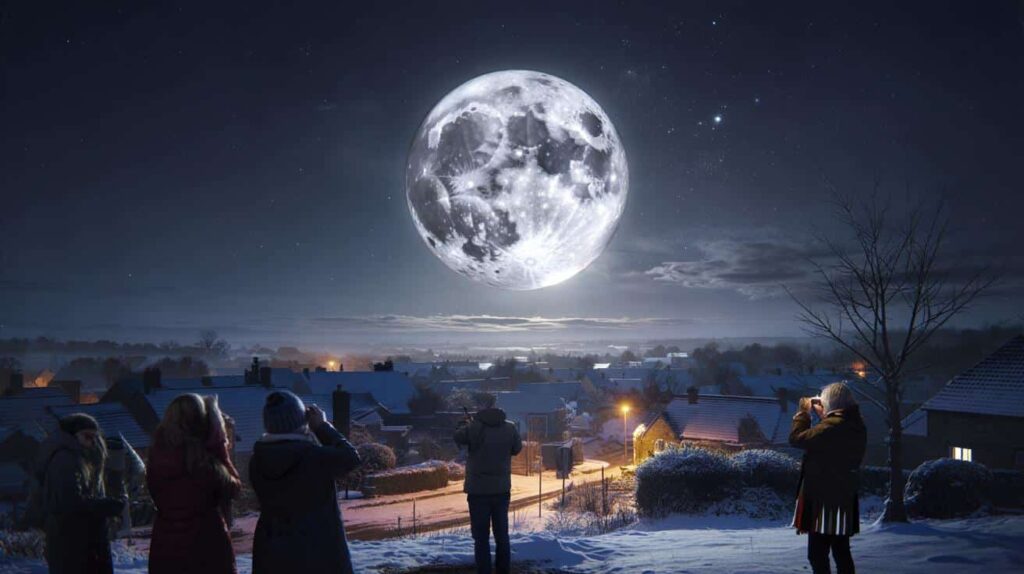
Snow Moon has peaked, but it still looks full
According to the Royal Observatory Greenwich, the Snow Moon reached its peak brightness at 10.09pm UK time on Sunday. That’s the precise moment when the moon sat directly opposite the sun, fully illuminated.
If you missed that exact time, you have not lost your chance. The full moon phase is more generous than the calendar suggests. For a day or two either side of the peak, the lunar disc still appears round to the naked eye.
 Heavy snow expected starting tonight
The Snow Moon will continue to look strikingly full in UK skies for at least another night, especially if conditions stay clear.
Over the next evenings, the moon moves into its waning gibbous phase. The illuminated area begins to shrink from the right-hand side, but to most casual observers it remains an impressive sight, particularly as it climbs above rooftops after dusk.
Why February’s full moon is called the Snow Moon
The February full moon is widely known as the Snow Moon, a name rooted in the harsh winters of northeast North America. NASA notes that Indigenous communities coined the term because February reliably brought deep snow and difficult conditions.
The same moon has carried other names over time:
- Storm Moon – linked to winter storms and unsettled weather
- Hunger Moon – a reference to scarce food and tough hunting during late winter
These names reflect the way people used the lunar cycle as a natural calendar long before smartphones and wall planners. The full moon marked a point in the season that everyone recognised: snow piling higher, supplies running lower, winter refusing to let go.
How Native American moon names shaped today’s calendar
Many of the full moon nicknames now used in headlines and social media come from Native American tribes, especially in the north and northeast of the United States. They watched the sky closely, tying each full moon to events in nature, harvests, animals or weather.
Colonial settlers later adopted these terms, and they gradually filtered into wider English use. Today, the names are used by astronomers, planetariums and weather forecasters as a simple way to keep people interested in what is happening overhead.
Behind the charming names lies a practical system: the moon acted as a seasonal clock, helping communities plan hunting, planting and gathering.
The year in full moons at a glance
The Royal Observatory Greenwich lists a series of names commonly used through the year. Here is a compact guide:
| Month | Full moon name | Seasonal meaning |
|---|---|---|
| January | Wolf Moon | Wolves howling in midwinter, when food was scarce |
| February | Snow Moon | Deep snow and harsh conditions |
| March | Worm Moon | Worm trails reappearing as frozen ground thaws |
| April | Pink Moon | Named for early blooming wildflowers, not colour |
| May | Flower Moon | Widespread blossoming as spring takes hold |
| June | Strawberry Moon | Linked to strawberry harvests in North America |
| July | Buck Moon | Male deer regrowing their antlers |
| August | Sturgeon Moon | Abundance of sturgeon fish in late summer rivers and lakes |
| September | Full Corn Moon | Late-summer crop harvesting, often into the night |
| October | Hunter’s Moon | Bright evenings supporting seasonal hunting |
| November | Beaver Moon | Period of beaver trapping or dam building |
| December | Cold Moon | Long, cold winter nights; also called Long Night Moon |
How to see the Snow Moon from the UK tonight
You do not need any specialist kit to enjoy the Snow Moon. Step outside after sunset, give your eyes a few minutes to adjust, and look roughly towards the east as the moon climbs. Later at night it will travel across the southern part of the sky.
Light pollution in cities can wash out faint stars, but it does little to dim the full moon. Even under street lamps, the lunar disc remains bright and clearly visible.
The most accessible way to watch the Snow Moon is with nothing more than your own eyes and a few spare minutes outdoors.

Binoculars, telescopes and what you’ll actually see
NASA suggests that binoculars are the sweet spot for casual observing. With a modest pair, you can pick out craters, dark lava plains (the maria) and some of the larger mountain ranges.
A small backyard telescope provides a very different experience. At high magnification, the full moon no longer fits comfortably in the field of view. Instead, the surface becomes a landscape of peaks, valleys and long channels called rilles, formed by ancient volcanic flows.
For many beginners, a stable tripod and basic binoculars are easier than a telescope. You spend less time wrestling with equipment and more time simply staring at the details on the lunar surface.
What makes a Blue Moon and why people talk about it
You might hear people mention a Blue Moon whenever there’s “an extra” full moon in the calendar. The moon takes about 29.5 days to cycle from one full phase to the next, so twelve cycles add up to roughly 354 days, not 365.
That mismatch means that about every two and a half years, we squeeze in a thirteenth full moon. That extra one is known as a Blue Moon. The term is also used when a second full moon appears within a single calendar month.
The phrase “once in a blue moon” comes from this odd timing quirk, as the event is occasional but not rare.
Despite the name, the moon does not turn blue in colour during these events. A genuinely blue-looking moon is far rarer and linked to atmospheric conditions such as fine dust or volcanic ash in the air.
Planning your own mini lunar watch
For anyone looking to turn the Snow Moon into a small event, the practical needs are simple. Warm layers, a clear horizon, and perhaps a flask of something hot if you are heading to a park or hilltop. A phone camera will struggle to capture what the eye sees, so many people treat it more as a moment than a photo opportunity.
Parents sometimes use full moons to get children interested in science. A quick game of “spot the shapes” on the surface can work surprisingly well: some see a “man in the moon”, others a rabbit, a face or a map of dark seas and bright highlands.
Key terms that help make sense of the Snow Moon
The language around the moon can sound technical, but a few ideas go a long way:
- Full moon: when the moon is directly opposite the sun and its Earth-facing side is fully lit.
- Waning gibbous: the phase just after full, when the lit portion slowly shrinks each night.
- Lunar cycle: the roughly 29.5-day journey from one full moon to the next.
- Rilles: long, narrow valleys or channels on the lunar surface formed by ancient lava flows or crust movement.
Understanding these terms turns the Snow Moon from a passing headline into something you can track and anticipate. Over a few months, patterns begin to stand out: the changing path of the moon in the sky, the way its rise time drifts later, and how its light affects the feel of an evening walk.
For many people in the UK, February can feel like a long, grey wait for spring. The Snow Moon offers a brief, bright marker in that stretch of winter, and there is still time to step outside and watch it glide silently over chimneys, trees and tower blocks before it fades back into the darker phases of the month.