The café is loud in that soft, indistinct way cities specialize in. Cups clink, music hums, someone laughs too hard at the next table. You’re there with friends, nodding at the right moments, smiling when the story seems to call for it. From the outside, everything looks fine. Better than fine, even.
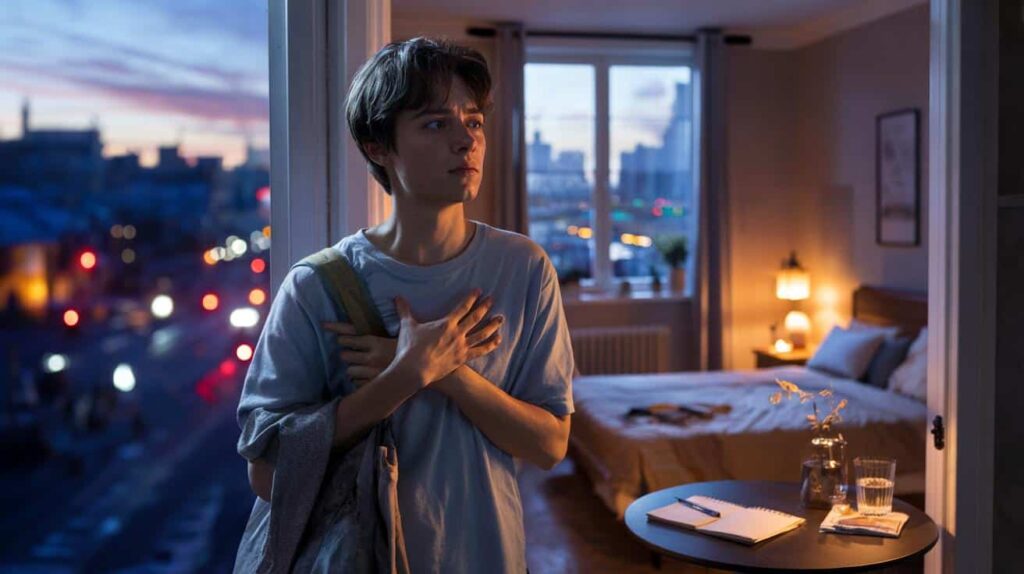
Inside, though, there’s a tiny countdown. A quiet wish for your own room, your own thoughts, your own air. Not because you hate them. Because you need to hear yourself again.
On the walk home, the tension drops from your shoulders one streetlight at a time. Alone, you finally feel your feelings arrive.

The calm is not emptiness.
It’s where the real work starts.
Why some people only breathe deeply when they’re alone
Watch a group conversation and you’ll often notice one person going quiet. Not out of shyness, more like they’ve stepped into an inner balcony, observing everything from a half-step away. Their face is present, their eyes alert, but their energy sits slightly back.
They’re not bored. They’re overwhelmed by data. Tone, words, contradictions, tiny shifts in mood. Their nervous system is taking notes while everyone else just talks.
For these people, solitude isn’t a luxury.
It’s a reset button.
Take Lea, 32, who works in a busy open-plan office. She’s known as the “calm one”, the colleague who never snaps in meetings, who absorbs last-minute changes without drama. People gush about her stability.
What they don’t see are the evenings. She gets home, drops her bag, switches off every sound in the apartment. Then sits on the edge of her bed and suddenly feels the anger from that passive-aggressive email. The sadness from a friend’s rushed phone call. The pride from a task she handled well.
All of it lands late, like delayed luggage at an airport.
This delayed emotional reaction isn’t a flaw. It’s a style of processing. Some brains are wired to observe and store first, then sort and feel later, away from stimulus. Crowded rooms keep the emotional tabs open. Solitude lets the browser finally load each page.
When you feel calmer alone, it often means your system can finally drop its guard. That lowered alert state makes subtle feelings rise from the background.
The quiet doesn’t erase emotion.
It intensifies it in a safer container.
How to use solitude without disappearing into it
One simple practice changes a lot: name one emotion, out loud, when you’re finally alone. Not a paragraph. Just a label. “I feel disappointed.” “I feel tight in my chest.” “I feel oddly proud.” Say it while brushing your teeth, washing dishes, taking off your shoes.
That tiny act turns a vague inner storm into something you can hold in your hand. Your brain shifts from drowning in sensation to observing it. It sounds small, almost silly.
Yet naming an emotion is like switching on a light in a cluttered room.
You still have stuff everywhere, but at least you can see it.
 Heavy snow expected starting tonight
Many deep processors fall into the same trap: they think solitude automatically equals healing. So they scroll, binge, overthink, replay conversations like a broken podcast. The body is alone, but the mind is a crowded stadium.
The key is to give your emotions a path, not just a place. A short walk without your phone. A two-line journal note. Lying on the floor for five minutes, focusing only on your breathing. Small, repeatable stuff.
Let’s be honest: nobody really does this every single day.
You don’t need perfection, just a few gentle habits that keep you from getting stuck in endless mental loops.
Sometimes, the people who seem the most distant in a room are the ones feeling the most. They’re not cold; they’re carrying a whole weather system inside and waiting for a quiet place to let it rain.
- Take 3 quiet minutes after social events before touching your phone.
- Write one sentence about what felt good, and one about what felt strange.
- Notice where emotion sits in your body: throat, chest, stomach.
- Use a simple phrase: *“Right now, I’m allowed to feel this.”*
- Stop as soon as you feel calmer; you don’t need to “finish” processing.
The hidden strength of people who need more quiet
There’s a strange cultural script that praises the loudest presence in the room. The fast talker, the nonstop social calendar, the person who “lives for people”. If you’re someone who exhales only when the door closes behind you, it’s easy to think you’re doing life wrong.
Yet step back and notice what you bring. You remember the throwaway comment that hinted at a breakup months before it happened. You sense tension before anyone names it. You feel guilty for days if you snap at someone because you replay it, learn from it, quietly repair.
That depth can be exhausting.
It’s also a form of emotional intelligence that rarely gets headlines.
The real shift comes when you stop comparing your emotional timing to everyone else’s. You’re not “late” to your feelings; you’re thorough with them. You don’t bounce back faster because you’re still integrating what happened when everyone else has already moved on.
This style of processing can build strong relationships, when you let people in on it. Saying to a partner, “I react slowly, I’ll probably need to think and come back to this tomorrow,” can change whole arguments. Saying to a friend, “If I go quiet after a party, it’s not you, it’s my brain defragging,” can stop a lot of misunderstandings.
You’re not flaky. You run on a deeper emotional operating system.
There’s another quiet gift here: people who feel calmer alone often become surprising anchors in crisis. While others spin out in the moment, your reflex is to absorb, hold, stabilize. Your emotional wave usually hits later, when the sirens stop and the room is empty.
That delay can hurt if you dismiss your own aftershock. Yet if you respect it, you get to be both the calm in the storm and the one who, later, really learns from what happened.
Some will always misread your quiet as distance.
The ones who matter will learn it’s where your empathy grows roots.
| Key point | Detail | Value for the reader |
|---|---|---|
| Solitude as processing time | Being alone lowers stimulation so stored emotions can surface and be felt | Reduces self-blame for “shutting down” socially and reframes it as a natural need |
| Simple emotional rituals | Short practices like naming feelings, brief walks, or one-sentence journaling | Gives practical tools to avoid overthinking and turn quiet time into real relief |
| Owning your emotional rhythm | Explaining delayed reactions to others and honoring your slower emotional wave | Improves communication, prevents conflict, and builds more respectful relationships |
FAQ:
- Is it “normal” to only understand how I feel hours after something happens?Yes. Many people have delayed emotional processing. Your brain first deals with the situation, then unpacks the feelings later when the environment is safer or quieter.
- Does preferring to be alone mean I’m antisocial or depressed?Not automatically. If you still enjoy people, have interests, and your mood is mostly stable, it often just means you recharge and process better in solitude.
- Why do I feel exhausted after social events, even when I had fun?Because your mind is tracking tone, reactions, and tiny social cues. That hidden work drains energy, and your body asks for alone time to reset and digest.
- How can I explain this to friends without sounding dramatic?Use simple, concrete phrases like, “I love seeing you, and I also need quiet time after. If I go offline later, it’s just me recharging, not a sign something’s wrong.”
- When should I worry that my love of solitude is a problem?If you stop answering messages entirely, lose interest in things you used to enjoy, struggle to work, or feel numb most of the time, talking to a professional can be a helpful next step.