The first time you spot a motionless bird under a frosty shrub, the garden suddenly feels heavier. The air is cold, the grass crunches under your shoes, and this tiny body lies there, too still, too quiet. A few steps away, the cat’s paw prints mark a guilty dotted line in the white lawn. You bend down, guilt mixing with sadness, wishing you’d done something sooner – but what, exactly, could you have done?
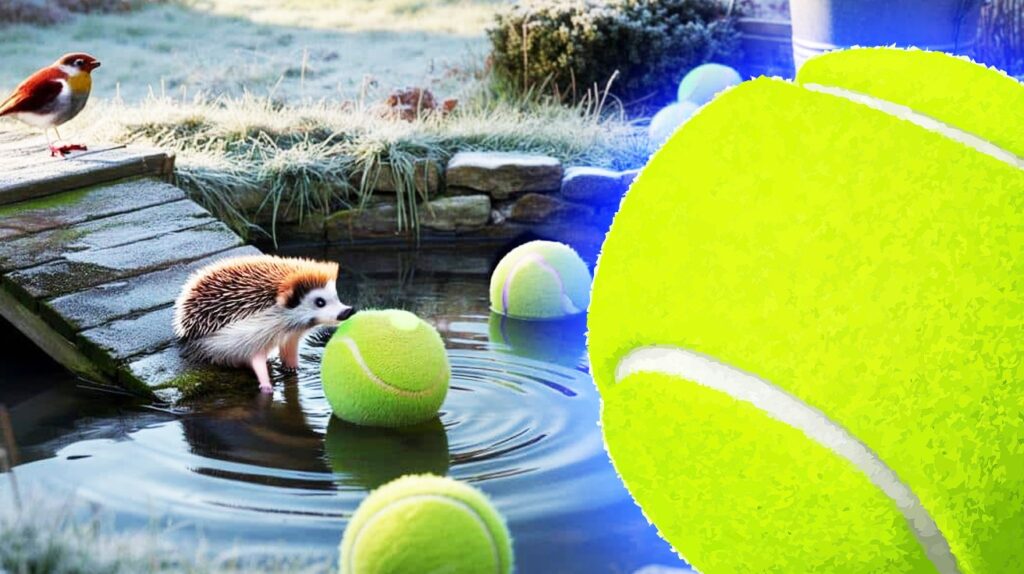
That’s usually the moment when people start looking for big solutions. Heated bird baths, elaborate shelters, expensive feeders. Yet sometimes, the game changer is smaller than your hand, and already hiding in a dusty sports bag in the garage.
A used tennis ball can quietly save a life.

A winter garden full of traps… that we don’t see
Walk through a typical garden in November or December. The leaves are wet and heavy, flowerbeds are half asleep, the lawn looks like a faded carpet. For birds and hedgehogs, this is not calm. This is survival mode.
They are hungry, low on energy and exposed. Open water bowls, steep-sided ponds, metal buckets, even drain covers become invisible traps for small, cold, exhausted animals. One slip, one bad landing, and they can’t get out.
Ask any wildlife rescue center what their busiest season is, and they’ll often point to late autumn and winter. That’s when they see hedgehogs pulled shivering from icy ponds or birds too soaked to fly after falling into deep water butts.
One volunteer in the south of England told me about a morning after a hard frost. In a single street, neighbors had brought in five hedgehogs, all found struggling in garden features that looked “safe” to humans. Simple plastic tubs, decorative barrels, tiny ponds that nobody thought twice about.
The pattern is brutally simple. Small bodies, cold muscles and smooth surfaces do not mix. A hedgehog that falls into a deep pond without a way out will swim until it’s exhausted, then drown quietly while we sleep. A robin that misjudges a landing on a slippery bird bath can end up soaked and hypothermic, unable to lift off. *Our cozy winter garden is their obstacle course from hell.*
Once you see it like this, you can’t unsee it. And suddenly a worn tennis ball stops looking like trash and starts looking like a tiny bright-green lifebuoy.
The tennis ball trick: a ridiculously simple lifeline
The principle is almost embarrassingly simple. Drop one or two tennis balls into any open water source in your garden: ponds, water butts, deep bird baths, troughs, barrels. That’s all.
The balls float on the surface, moving with the wind and the ripples. For a tired bird or a hedgehog that’s fallen in, this bobbing ball becomes something solid to cling to, a step, a raft, a breathing space. It buys them minutes. And in winter, minutes are everything.
Most people think safety means fences, covers, big barriers. Then they stare at the pond and sigh, because fencing the whole thing feels complicated, expensive, ugly. So they do nothing.

Let’s be honest: nobody really installs a perfect wildlife-friendly setup in one weekend. Life gets in the way. The beauty of the tennis ball fix is that it’s zero-skill and almost instant. You can do it in slippers, coffee in hand, before work. A two-second gesture that quietly upgrades your garden from “pretty” to “life-saving”.
Wildlife carers have a simple way of explaining it.
“As soon as you put something buoyant in deep water,” one hedgehog rescuer told me, “you turn a death trap into a second chance. That’s all most animals need – a second chance.”
Alongside the balls, small tweaks amplify that second chance. Here are three easy add-ons:
- Add a rough “escape ramp” (a plank with chicken wire, a big stone at a gentle angle) to at least one side of the pond.
- Place a shallow dish of water at ground level so hedgehogs don’t have to lean over steep edges.
- Check all open containers after cold nights: buckets, tubs, kids’ sandpit shells, even folded tarpaulins that can trap water.
None of this turns your garden into a nature reserve. It just quietly reduces the number of tiny funerals under the shrubs.
A small ball, a bigger question
There’s something almost disarming about how low-tech this gesture is. No app, no special gear, no long tutorial. Just a scuffed ball that used to fly over a net, now drifting slowly on a ripple, waiting for a claw or a paw.
It nudges us to look at our gardens differently. Not as polished outdoor rooms, but as busy little territories where our choices set the rules of the game. A toy left in the grass, a barrel left uncovered, a pond left smooth and steep – they all say something to the creatures passing through.
Once you start with tennis balls, you might notice other quick wins. A pile of leaves you don’t tidy up becomes shelter. A gap under the fence becomes a hedgehog highway. A less “perfect” garden suddenly reads as more alive, more honest, less hostile.
The gesture is tiny, yes. Yet when neighbors copy you, when whole streets quietly add floating lifelines to their water, the map of winter danger zones gets redrawn. And sometimes that’s how change really starts: not with a grand project, but with somebody standing by a cold pond at dusk, dropping in a single, fluorescent green promise.
| Key point | Detail | Value for the reader |
|---|---|---|
| Floating tennis balls act as lifebuoys | They give birds and hedgehogs a solid surface to rest on if they fall into deep or steep-sided water | Reduces risk of drowning and hypothermia in a few seconds of effort |
| Works with existing garden features | Can be used in ponds, water butts, troughs, buckets and large bird baths | Saves money and time, no need for complex new installations |
| Combines well with other small tweaks | Ramps, shallow dishes and nightly checks multiply the protective effect | Turns an ordinary garden into a safer micro-refuge for local wildlife |
FAQ:
- Do tennis balls really help hedgehogs escape from ponds?They don’t replace a ramp, but they give a floating support for an exhausted animal to cling to or rest on, which can keep it alive long enough to reach an escape route.
- Can I use any kind of ball or does it have to be a tennis ball?You can use any floating ball of similar size that doesn’t absorb too much water, though classic tennis balls are ideal because they’re bright, cheap and easy to find.
- Won’t the balls scare birds away from drinking?Most birds adapt quickly and will simply drink from a clear patch of water; you can leave part of the surface more open if you’re worried.
- How many tennis balls do I need for a small garden pond?Usually one or two are enough for a small pond, while a larger pond or trough might benefit from three or four spread out across the surface.
- Do I need to clean or replace the tennis balls over time?Yes, give them a quick rinse now and then and replace them when they become waterlogged, moldy or start to break apart so no debris ends up in the water.