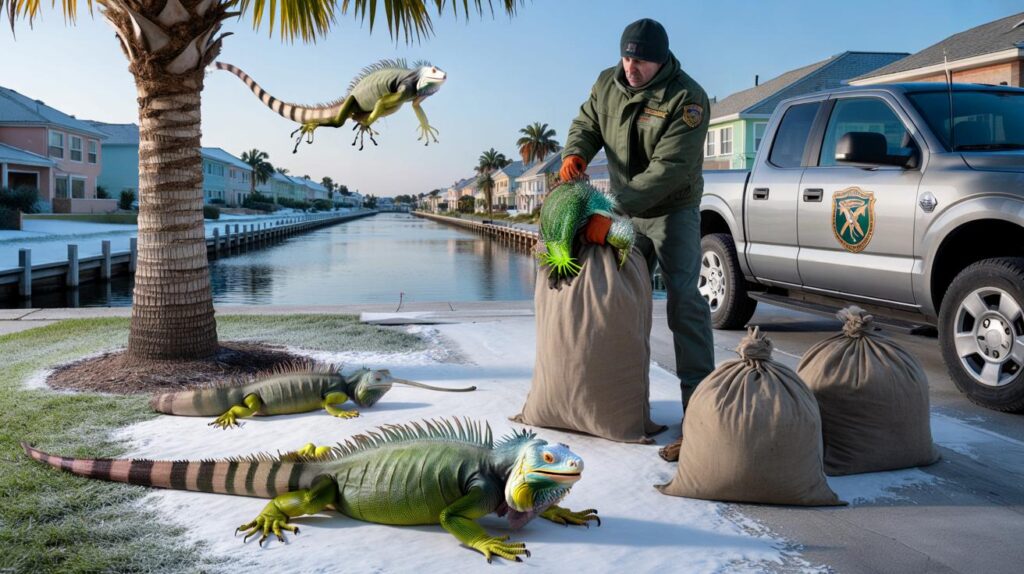
As an unusually sharp cold wave hits the southern United States, green iguanas are literally dropping from the branches, paralysed by low temperatures — and state wildlife officials are urging residents to collect them so the invasive reptiles can be euthanised.
When tropical reptiles meet a rare southern freeze
The cold blast has swept across several southern states, including North Carolina and neighbouring regions, but Florida has drawn the most attention. Cities more used to sweltering humidity woke up to temperatures below freezing. Orlando, in central Florida, briefly dipped to around -4°C, a figure that might not raise eyebrows in Chicago but is strikingly low for the Sunshine State.
For green iguanas, which evolved in warmer Latin American climates, that kind of chill is a serious problem. They are cold‑blooded reptiles, meaning their body temperature depends almost entirely on the environment. When the air cools rapidly, their metabolism slows and their muscles seize up.

At around 0°C, many iguanas become so sluggish they stiffen, losing their grip on branches and tumbling from trees like scaly, green fruit.
Videos shared on social media have shown motionless iguanas scattered on lawns, pavements and car parks. Some look dead. In reality, most are simply in a state similar to deep torpor, and can recover once the sun returns.
Not dead, just frozen — and now targeted
Florida’s wildlife agency, the Florida Fish and Wildlife Conservation Commission (FWC), has been quick to clarify that the reptiles are not instantly killed by the cold. As temperatures climb back up, many animals regain movement, scampering off as if nothing happened.
This time, though, officials are asking residents not to walk past the rigid lizards. They want them picked up.
Under a temporary executive order, anyone can capture cold‑stunned green iguanas without a permit and deliver them to designated FWC offices for euthanasia or controlled resale.
The commission describes the euthanasia as “humane”, in line with accepted veterinary methods. A small number of animals may be transferred to licensed dealers for the live pet trade, but the stated priority is population control.
Why Florida wants fewer green iguanas
Green iguanas are not native to Florida. They arrived decades ago through the pet trade and likely through accidental releases. With a warm climate, abundant water and few natural predators in urban areas, they have bred quickly and spread through much of the peninsula.
FWC officially classifies them as an invasive species, and lists several reasons for cracking down on their numbers:
- They compete with native species for food and nesting sites.
- Their burrows can undermine sea walls, canals and building foundations.
- Their droppings can foul swimming pools, docks and patios.
- Large males can behave aggressively if cornered, posing a risk of bites and scratches.
Officials argue that letting the population expand unchecked would mean higher costs for property owners and more pressure on already stressed native wildlife.
A year‑round green light on private land
In Florida, these reptiles receive no legal protection. Residents are allowed to kill green iguanas on their own property at any time of year, or on someone else’s land with the owner’s permission, provided they follow humane methods and local regulations.
The current cold‑weather order simply broadens that approach, making it easier for ordinary people to assist wildlife officers during a brief window when the animals are slow and easy to catch.
How officials want people to handle frozen iguanas
As strange as it might feel to scoop up a stiff, seemingly lifeless lizard, the agency is treating this as a public‑safety exercise as much as a wildlife‑management one. Their guidance is detailed and practical.
Residents are urged to dress as if they were handling a stray cat with claws: thick gloves, long sleeves and long trousers.
The FWC’s key recommendations include:
 Starlink activates satellite internet on mobile : no installation and no need to change your phone
- Wear gloves to avoid scratches and potential bacteria on the skin.
- Use long sleeves and trousers to protect arms and legs.
- Place each iguana in a sturdy cloth bag or other non‑leaking fabric cover.
- Ensure the bag is secured so the animal cannot escape once it warms up.
- Transport the bagged reptiles to one of five designated wildlife offices.
Staff at those offices either carry out euthanasia on‑site or move animals on to licensed facilities. Residents are not asked to perform the killing themselves as part of the programme, although existing law does allow property owners to do so humanely.
Ethics, ecology and a very public cull
The sight of dazed, immobile iguanas being collected in sacks has stirred debate both in Florida and online. Some locals see it as a straightforward ecological necessity. Others feel uncomfortable with the idea of using a cold snap as an opportunity to cull animals that, to many, have become part of the state’s visual identity.
Wildlife biologists tend to frame the issue in terms of trade‑offs. Leaving invasive species alone can cause slow but significant damage to native ecosystems. At the same time, any lethal control raises questions about animal welfare and the human role in creating the problem in the first place, since most invasions begin with human activity.
Florida’s policy rests on the argument that non‑native predators and herbivores, from iguanas to pythons, are pushing local species closer to the brink.
Green iguanas eat plants, eggs and sometimes small animals. Their burrowing disrupts nesting sites for shorebirds and sea turtles. In densely built areas, their tunnels can weaken canal banks and pavements, leading to expensive repairs for councils and homeowners.
What “humane euthanasia” means in this context
The phrase “humane euthanasia” appears frequently in state statements, but it can be vague for the general public. In practice, wildlife agencies rely on techniques that cause loss of consciousness within seconds and prevent the animal from waking.
For reptiles, the process often has two stages: chemical or physical stunning, followed by a secondary step to ensure the brain is irreversibly damaged. This two‑step approach is recommended by veterinary guidelines for cold‑blooded animals, whose nervous systems can react differently from those of mammals.
Residents are strongly discouraged from improvised methods such as drowning or slow freezing, which can prolong suffering.
What residents might face in coming years
If winters in southern states remain relatively mild, frozen iguana alerts may stay rare and attention‑grabbing. Yet climate data over the past decade show increasing weather volatility. Short, sharp cold snaps can still occur even as average temperatures rise.
In practice, that means Floridians may hear more warnings from the National Weather Service about “falling iguanas” during future cold spells. Local authorities could treat each event as a chance to thin out populations in neighbourhoods where complaints are frequent.
For households, that raises practical questions. Gardeners may need to think about netting vulnerable plants or patching gaps under patios and sheds where reptiles might shelter. Parents will need to decide how to explain to children why apparently “sleeping” lizards are being removed in bags and not simply warmed up on a towel.
Key terms and real‑life scenarios
The term “invasive species” describes animals or plants introduced outside their natural range that spread and cause economic or ecological harm. In Florida’s case, green iguanas share that label with Burmese pythons, lionfish and several non‑native fish and plant species.
Imagine a typical suburban canal in Miami: concrete banks, a few coconut palms, manicured lawns backing onto the water. A single female iguana can lay dozens of eggs each year in burrows along the bank. Over a decade, without predators or human control, that canal could host hundreds of lizards, their tunnels riddling the soil beneath patios and pool decks.
Now factor in stronger rainstorms and rising water levels pushing against weakened structures. For local councils and insurers, the cost of preventing that scenario can seem lower than the long‑term price of constant repairs. That calculation underpins many of the state’s tougher invasive‑species policies.
Residents who dislike the idea of euthanising iguanas still have options. They can work with licensed trappers who relocate animals to facilities, or lobby for tighter controls on the exotic pet trade that continues to feed new species into the wild. The frozen lizards falling from trees this winter are, in many ways, a visible symptom of that much bigger conversation about how humans move animals around the planet — and what happens next when the weather suddenly turns cold.