Colorful swim caps, foam noodles, a whistle echoing against the tiles. On the bench near the entrance, Marie, 72, watches the bustle while rubbing her right knee through her leggings. Her doctor told her to swim more. Her neighbor swears by Pilates. Her joints, frankly, are not impressed by either.
She tried swimming first. The water did feel good, but getting in and out of the pool with slippery steps and cold air on wet skin? Exhausting. Pilates was elegant on YouTube, but on the mat, her wrists and shoulders complained louder than her osteoarthritis ever had.
So Marie did what many people over 65 quietly do: she stopped. Until her physiotherapist suggested an activity she had never taken seriously, and that is quietly becoming the real game-changer for painful joints.

Why walking – but not just any walking – beats the “fancy” activities
The activity that keeps coming up in serious research for over 65s with joint problems is not glamorous. It doesn’t need equipment, membership cards, or special shoes. It is simply walking – but structured, deliberate, and slightly smarter than “I walk when I do my shopping”.
When walking is done at the right pace, on the right surface, and for repetitive short bouts, it beats many “softer” sports for joint health. Especially for knees, hips, and lower back. The body loves that repetitive, low-impact movement. Cartilage is nourished by movement, not by rest. Blood circulation improves. Muscles that stabilize the joints wake up again.
And unlike swimming or Pilates, you don’t have to fight pool schedules, changing rooms, or complicated positions. You open the door. You step outside. You start. Simple, yes. But not random.
Take Louis, 68, ex-delivery driver with worn-out knees. For years, every doctor visit ended with the same sentence: “You should swim.” He tried. Twice. Once he forgot his towel, the second time the pool was closed for maintenance. That was the end of his aquatic career.
His granddaughter later bought him a watch that counts steps. Louis started noting down his walks on a small calendar on the fridge. First week: 1,500 steps a day. His knees hurt and he limped back home. His physiotherapist didn’t tell him to stop. She told him to walk shorter, more often, on flat sidewalks.
Three months later, he was doing three 12-minute walks a day. His average pain, on a scale from 0 to 10, had dropped from 7 to 3. He’d lost 3 kilos without “being on a diet”. The biggest surprise? He slept better on the days he walked.
Joint pain isn’t only about “too much wear”, it’s also about “not enough movement”. When we stop moving, the muscles that protect our joints weaken. The joint becomes less stable, so every step feels sharper, heavier. That’s when fear sets in. We move even less, and the spiral continues downward.
Walking interrupts that spiral gently. The impact is much lower than people imagine, especially on flat, regular ground, with good shoes. No sudden twists like tennis, no forced positions like some Pilates moves, no extreme ranges like breaststroke legs in the pool.
There’s also the brain. Walking outside stimulates balance, coordination, and attention in a way that a mat class rarely does. The environment changes, the eyes scan the surroundings, the inner ear adjusts. Joints are mechanical, but pain is also a story the brain tells. A regular, safe walk softens that story.
How to walk when your joints already hurt
The most effective method for over 65s with joint problems is what many physiotherapists now call “interval walking for real life”. Not the athletic version. The gentle one. You choose a time, not a distance. For example: 10 minutes.
You start with 3 minutes very slow, almost like strolling. Then 4 minutes at a “conversation” pace: you can talk, but you feel your body working slightly. You end with 3 minutes very slow again. That’s one session. Done. You rest for at least two hours before doing another, if you feel like it.

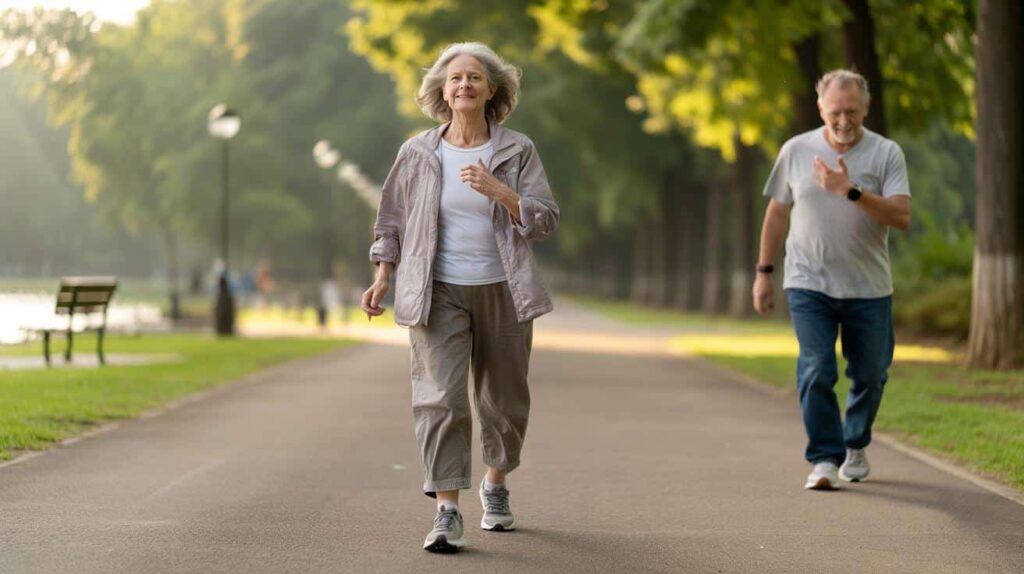
The secret is not to chase performance. The secret is repetition. Short walks, almost every day, on terrain you trust. A park path, a wide, flat sidewalk, the gallery of a mall on rainy days. You can use benches as “micro-goals”: from this bench to that lamppost, and back.
There’s a trap that almost everyone falls into: doing too much on a “good” day. The knee feels lighter, the hip less stiff, so you walk twice as long, sometimes with a bit of pride. The next morning, the joint is on fire. You blame the walking. You think, “Clearly this activity isn’t for me.”
That’s not failure, that’s human. We forget that joints over 65 often react with a 24–48 hour delay. What you did joyfully on Tuesday may swell on Wednesday. The idea isn’t to be scared of walking. It’s to organize it like medication: the right dose, at the right time, regularly.
Another frequent mistake is wanting to “walk properly” from the outset. Long stride, big arm swings, fast pace. That looks sporty, but for an arthritic knee, it’s a small earthquake. Shorter steps are gentler. A good rule of thumb: if your pain jumps more than two points on your usual scale during or after walking, that session was too ambitious.
As one geriatrician told me recently, “The problem is not that older people don’t move enough. It’s that we gave them the idea that movement has to be complicated, or done in special places, to count.” His patients who do best are not the ones enrolled in the trendiest classes. They’re the ones who organize their weeks around simple, predictable walks.
- Start tiny – 5 to 8 minutes once a day for the first week, even if you “feel you could do more”.
- Pick a route you know by heart – so you can focus on your body, not on where to go.
- Use pain as a guide, not a verdict – slight discomfort is normal, sharp or rising pain means slowing down, not giving up entirely.
- Plan rest chairs or walls to lean on – seeing them on the way reduces anxiety before you even start.
- Keep one “no negotiation” walking date a week – a short, sacred appointment with yourself that anchors the habit.
Walking as a quiet way of reclaiming your body after 65
Behind this story of joints and steps lies something bigger: the right to inhabit your own body without feeling fragile or “finished”. Walking doesn’t demand much, and that’s precisely why it can bring back confidence. You don’t have to change clothes, you don’t have to be seen in a swimsuit, you don’t have to understand an instructor’s vocabulary.
What often changes first isn’t the X‑ray of the knee. It’s the relationship with time. A 12-minute walk creates a small frame in the day, a kind of moving pause. The phone stays in the pocket. The world shrinks to what your feet, your breath, and your eyes are doing. *For many people over 65, this is the first “appointment with their body” they’ve had in years, outside of medical offices.*
Let’s be honest: nobody really does this every single day. Life gets in the way. Grandchildren arrive, it rains for a week, pain flares up, motivation vanishes. The point is not perfection. The point is not giving up completely at the first skipped walk, the first bad morning. The body is more forgiving than we think when we treat it with consistency and gentleness.
There is also a social dimension. Two neighbors who walk together once a week talk about their grandchildren, their fears, the new bakery. Joints warm up; words flow more easily when the body moves. Some communities now organize “slow walking groups” for seniors with pain, without speed goals. Those who come for their knees often stay for the company.
The pool and Pilates are not the enemies here. They remain excellent options for those who love them and can access them regularly. The quiet revolution lies elsewhere, on the sidewalks and park paths, with these people who lace up their shoes not to “get back into shape” but simply to stop the decline, to feel a little less stiff, a little less old.
When doctors describe walking as “the best activity for over 65s with joint problems”, it can sound almost disappointing. Many people expect a new technique, a special program, something more sophisticated. Yet this apparent simplicity is its greatest strength. No subscription, no fancy equipment, no age limit.
Maybe the real question is not “What is the best activity?” but “What activity can I honestly see myself doing most weeks, in my real life, with my real joints?” For a huge number of people over 65, the honest answer is not swimming, not Pilates, not a gym class. It is a path from the front door to the corner, and back. Then a little further. Then again, next week.
| Key point | Detail | Value for the reader |
|---|---|---|
| Structured short walks | 10–15 minutes with slow–moderate–slow intervals, repeated several times a week | Protects joints without overloading them and fits easily into daily life |
| Use pain as a guide | Accept mild discomfort, stop or reduce if pain rises sharply or lasts more than 48 hours | Reduces fear of movement while avoiding real flare-ups |
| Familiar, flat routes | Sidewalks, parks, shopping centers with benches and safe surfaces | Improves confidence, balance, and regularity of the new habit |
FAQ:
- Question 1Isn’t swimming still better for my joints than walking?
- Answer 1Swimming is excellent, especially for global fitness, but it’s less accessible and harder to keep up for many people over 65. Walking wins in real life because you can do it almost anywhere, in normal clothes, without depending on pool times, transport, or changing rooms.
- Question 2How often should I walk if my knees already hurt?
- Answer 2Starting with 3 to 5 days a week of very short walks is usually enough. Aim for 8–12 minutes per outing, at your own pace, then slowly add time or an extra walk once your pain stabilizes or decreases.
- Question 3Is it normal to feel more pain at the beginning?
- Answer 3Yes, mild extra discomfort in the first days or weeks is common as muscles and joints “wake up”. What you want to avoid is sharp, sudden pain or pain that clearly worsens after each walk. In that case, cut the duration in half and talk with your doctor or physiotherapist.
- Question 4Do I need special shoes or insoles?
- Answer 4Comfortable, closed shoes with a flexible sole and good cushioning are usually enough. If you have deformities, very flat feet, or repeated pain in the same spot, insoles from a specialist can help, but they are not mandatory to start.
- Question 5What if I lose balance easily or fear falling?
- Answer 5Start in ultra-secure places: inside your home, in a hallway, in a corridor with handrails, or in a mall with smooth floors. Walk with someone, or use a cane or walking poles. Safety first, speed later – or never.