On a hazy morning in the South China Sea, the horizon looks wrong. Where old fishing charts show only open water and scattered reefs, long strips of pale sand now break the waves, dotted with radar domes, runways and the bright red of freshly painted helipads. From the deck of a wooden boat, an older Filipino fisherman squints at a distant crane and mutters that when he was young, “that place was just sea and sky”. Now, land has appeared where no island existed before.
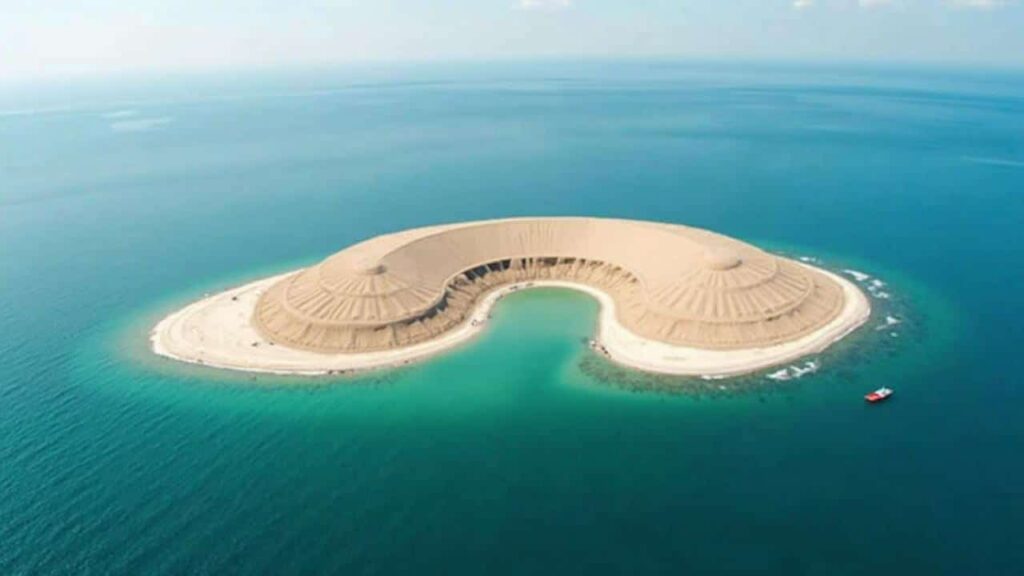
For more than a decade, China has been pouring sand and gravel into contested waters, literally constructing new pieces of the map. The result is a chain of brand-new islands bristling with concrete, antennas and flags. The legal seabed has been turned into strategic high ground.
The world is left staring at a simple but explosive question: if you build an island from scratch, do you also get to rewrite who owns the ocean around it?

From empty blue to concrete outposts
The scale of China’s sand-dumping campaign is easiest to grasp from the air. Satellite images taken between 2013 and 2016 show tiny reefs transforming month by month into solid, geometric shapes. Mischief Reef, once a barely visible coral ring that vanished at high tide, has swelled into a sprawling, gray-and-green platform with a 3,000-meter runway, harbors and storage depots. What used to be a navigational hazard for passing ships now looks more like a forward operating base dropped into the middle of turquoise water.
Fishermen from Vietnam and the Philippines talk about the sea as if it were a city under construction. They describe dredgers crawling across the horizon at night, sucking sand from the seabed and spewing it in great arcs over shallow reefs. Some remember the first time they saw **massive Chinese ships** circling a place they’d always treated as a shared fishing ground. Months later, the water was suddenly shallower. Then patrol boats appeared. Then concrete.
Engineers didn’t simply pile sand and hope for the best. They used cutter-suction dredgers to carve out huge volumes of sediment, then reinforced the new land with rock, cement and steel pilings. The islands were ringed with sea walls to stop erosion, and the highest points were raised to withstand storms. From a technical point of view, it’s a breathtaking feat of maritime engineering. From a legal and political point of view, it’s a grenade rolled gently under the conference table.
Who owns a man-made island?
On paper, the rules seem clear. Under the UN Convention on the Law of the Sea, natural islands can generate a 12-nautical-mile territorial sea and, if they support human life, an exclusive economic zone stretching 200 nautical miles. Artificial islands are different. They don’t create new territorial seas. They don’t change who owns the surrounding waters. They’re supposed to be treated more like big offshore platforms than new countries in miniature.
That tidy legal distinction collides head-on with the reality on the water. China’s sweeping “nine-dash line” claim runs across almost the entire South China Sea, overlapping the exclusive economic zones of the Philippines, Vietnam, Malaysia and Brunei. A 2016 international tribunal in The Hague ruled that Beijing’s historic-rights argument had no legal basis and said many of the disputed features are legally rocks or low-tide elevations, not full islands. Beijing rejected the ruling. The sand kept flowing. The islands kept rising.
The result is a high-stakes game of facts on the ground. If you build an airstrip, park coast guard vessels and station troops on a feature, you send a clear message about who is “in control”, regardless of what legal textbooks say. Countries like the Philippines and Vietnam protest on paper, file diplomatic notes, and send their own patrols, but a patrol boat can only stay so long. A reinforced island with a freshwater plant and a solar farm can host people year-round. That gives Beijing a permanent, physical presence exactly where the ownership of the sea is most contested.
Living with a moving coastline
For coastal communities around the South China Sea, the argument over sand and sovereignty shows up as something more intimate: a subtle but relentless shift in daily life. A Filipino captain who once sailed freely to Scarborough Shoal now checks social media updates from Manila before each trip, looking for warnings about fresh blockades or water-cannon incidents. Vietnamese families in coastal villages talk quietly about cousins who were turned back by Chinese coast guard cutters near once-accessible grounds. Lines on a map feel abstract until a patrol boat appears on the horizon and orders you to turn around.

One story echoes across several countries. A generation ago, older fishermen say, the sea felt like a generous neighbor. Boats from different nations shared anchorage at night, waving to each other as they hauled in nets from the same reef. Over the past decade, that easy coexistence has often been replaced by tension. There are accounts of nets slashed, buoys cut, engines rammed. A Filipino crew that ventured near a newly built Chinese outpost recalls being chased, photographed and shadowed for hours by a ship many times their size. “They told us this is their water now,” one crew member said. “But my father fished here. His father too.”
The legal world has its own version of this unease. Lawyers, diplomats and security analysts are stuck wrestling with questions the law never fully anticipated. What happens if artificial islands are treated, in practice, like real ones? Do new sand-and-concrete platforms quietly shift regional baselines, even when treaties say they shouldn’t? There’s a plain-truth tension here: **states rarely give up ground once they’ve built on it**. Environmental scientists add another layer of concern, pointing to damaged coral reefs, disrupted fish stocks and altered currents around dredged areas. To them, this isn’t just a border dispute, it’s a slow-motion rewriting of a fragile marine ecosystem.
How power is signaled in the middle of the sea
The choreography around these new islands is precise. Chinese naval and coast guard vessels patrol regularly, but they’re not just loitering. They escort Chinese fishing fleets, shadow foreign ships and respond when other states send resupply missions to their own outposts. Crews on Vietnamese or Philippine boats describe a ritual: radio calls in rigid phrasing, warnings to leave, sometimes a siren or a blinding searchlight at night. Every encounter is both practical and symbolic, a small performance about who really calls the shots in those waters.
For smaller countries, navigating this reality is a daily balancing act. Push back too hard and you risk a dangerous escalation at sea that nobody truly controls once adrenaline kicks in. Avoid the area completely and you quietly surrender your presence, which may later be used as “evidence” that the other side has uncontested control. We’ve all been there, that moment when standing your ground feels right but walking away feels safer. On the high seas, that kind of dilemma comes with live cameras, national pride and sometimes live ammunition.
Regional governments often fall into two common traps. One is assuming that a single legal victory, like the 2016 Hague ruling, will magically reset behavior on the water. The other is treating each incident as isolated theater, without seeing the pattern. Diplomats and analysts who follow the region closely tend to say the same thing: what matters is sustained, visible presence and clear communication of red lines. Let’s be honest: nobody really does this every single day. Domestic politics, budget cuts and leadership changes interrupt even the best strategy. In that fragmentation, new sand keeps appearing where old maps still show unbroken blue.
China’s foreign ministry frames the whole thing very differently. Officials repeat that the islands and “relevant adjacent waters” are “inherent territory of China”, emphasize that the facilities are “mainly civilian” and stress that construction brings “public goods” such as lighthouses, search-and-rescue centers and weather stations for the region.
- Visible presence
Ships, overflights and scientific missions that signal continued interest without direct confrontation. - Legal groundwork
Filing diplomatic protests, updating maritime laws, and documenting incidents for future tribunals. - Quiet partnerships
Joint patrols, shared coast guard training and intelligence sharing among Southeast Asian states. - Storytelling power
Explaining to domestic audiences why distant reefs matter for food security, jobs and national identity. - Environmental defense
Using marine protection, reef science and climate resilience as a non-military way to contest reckless building.
A new kind of frontier, still shifting
In a sense, the South China Sea has become a laboratory for 21st-century power. Not the old version, where armies met on a battlefield, but a slow, patient layering of concrete, radar beams and legal filings across a fluid space. China’s 12-year sand-dumping experiment shows how technology, money and political will can turn a low-tide reef into a heavily armed landmark in less than a decade. The world is still catching up to what that means. *If you can manufacure land in contested water, the old comfort of “natural borders” starts to feel strangely outdated.*
For people far from Asia, this can sound distant, like someone else’s storm. Yet the fight over who owns which patch of ocean touches on global questions: who sets the rules for sea lanes that carry a third of the world’s trade, who controls fish stocks already under climate stress, who decides where undersea cables and pipelines run. The debate now playing out around these artificial islands hints at arguments to come in the Arctic, around undersea mining zones, even in places where rising seas might erase existing coasts. The map is not as fixed as we like to pretend. Today it’s sand piled on a reef in the South China Sea. Tomorrow it might be a seawall, a floating city, or a new island built somewhere nobody is really watching yet.
| Key point | Detail | Value for the reader |
|---|---|---|
| Artificial islands don’t create legal seas | Under UNCLOS, man-made structures don’t generate new territorial waters or exclusive economic zones | Helps decode the gap between what international law says and what’s happening on the water |
| Facts on the ground matter | Runways, ports and patrols give China daily control around disputed features despite legal challenges | Shows why visible presence and long-term strategy are crucial for smaller states |
| Local lives are directly affected | Fishermen face blockades, environmental damage and changing access to traditional grounds | Makes a distant geopolitical story tangible and relatable through human impact |
FAQ:
- Question 1Are China’s man-made islands considered real territory under international law?
- Question 2Why did China start dumping sand in the South China Sea in the first place?
- Question 3What did the 2016 Hague tribunal actually decide about these islands?
- Question 4How is this construction affecting the environment and local fishing?
- Question 5Could other countries copy this strategy and build their own disputed islands elsewhere?