The first thing you noticed wasn’t his face, was it?
It was the shoes. Scuffed black dress shoes on a man in a razor-sharp suit, standing in front of you at the coffee shop. The rest of his outfit screamed promotion. His shoes whispered, “I’ve been running to catch up.”
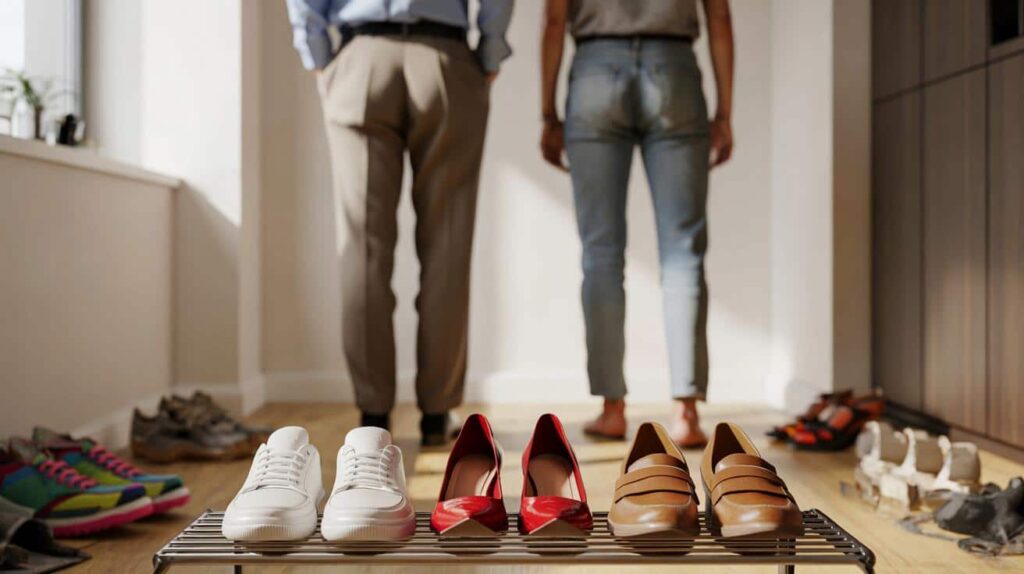
We all do this silent reading of people, dozens of times a day.
On the subway, scrolling social media, in the office corridor. Clean white sneakers, towering stilettos at 8 a.m., battered running shoes that have clearly seen more than one marathon.
Psychologists say this instinct isn’t just shallow judgment. It’s pattern recognition.
And your own shoe rack might be saying more about your confidence and personality than you think.

The quiet psychology hiding in your shoe closet
Look down at your feet for a second.
Are you in sneakers, boots, loafers, heels, sandals? That “quick choice” you made this morning wasn’t so random.
Studies in personality psychology suggest people tend to choose shoes that quietly support the story they tell themselves.
The bold red heel, the minimalist white trainer, the practical ankle boot: each carries clues about how you handle attention, comfort, risk, and even social pressure.
What feels “normal” to you can look like a confidence statement to everyone else.
Your shoes are often the first line of your biography, told without a single word.
One often-cited experiment from researchers at the University of Kansas asked strangers to guess people’s personalities just by looking at photos of their shoes.
No faces. No clothes. Just shoes.
Participants could correctly estimate traits like age, income range, even emotional stability more often than chance.
People in clean, well-maintained shoes tended to be seen as more conscientious and reliable. Those in bright, unusual styles were perceived as more extroverted and open to experience.
Think about your friends: there’s always that one person who lives in dramatic boots, and another who rotates the same quiet, perfectly kept sneakers.
You already know, without saying it aloud, which one is more likely to start a group trip or quit a job overnight.
Psychologists explain this through a mix of “self-presentation” and comfort zones.
We dress to feel like ourselves, but also to send signals about the role we believe we occupy.
If you secretly doubt your place in a room, stiff new shoes can feel like armor.
If you feel grounded and at ease, you might lean toward shoes that let you move freely, without thinking about every step.
*The truth is, shoes that fight who you are will always end up abandoned at the back of the closet.*
That quiet rejection says as much about your real personality as the pairs you wear every single week.
What your daily shoe choices quietly reveal about your confidence
There’s a simple self-test psychologists like to adapt: the “wardrobe reflection.”
This time, do it just with shoes.
Line up your three most worn pairs, not your favorites “in theory.”
Work shoes. Weekend shoes. The emergency pair you throw on when you’re late. Look at them like they’re someone else’s.
Ask three questions:
Do these shoes demand attention, or avoid it?
Are they more about comfort, or about image?
Do they look like they belong to one clear identity, or three different people?
The more your shoes match the life you actually live, the higher your quiet, stable confidence tends to be.
When there’s a big gap, it often means you’re still negotiating who you feel allowed to be.
One woman I interviewed for a lifestyle feature had a row of painfully high designer heels lined up like trophies.
She almost never wore them. Her daily reality? Flat loafers, slightly worn at the back, and one pair of soft sneakers with a faint coffee stain.
She admitted the heels were “aspirational”: a version of herself she thought she should become, scrolling through Instagram.
But on big presentation days, she still chose the broken-in loafers. “I feel like me in those,” she said. “And I need that when I’m nervous.”
That’s the paradox psychologists see often.
The shoes we grab for key moments are usually the ones that support our inner sense of competence, not the ones that simply look powerful on a shelf.
From a psychological angle, confidence isn’t loud.
It’s consistent.

People who feel at home in themselves tend to wear shoes that are aligned with their lives, bodies, and energy.
They don’t force a persona that exhausts them by noon.
On the flip side, if your everyday shoes are always uncomfortable “because that’s what people expect here,” your self-image is probably running on external approval.
Let’s be honest: nobody really does this every single day without paying the price somewhere else.
The plain truth is, **your most worn pair is usually your most honest pair**.
Not the flashiest, not the trendiest. The one that tells the story of how you move through the world when no one is really watching.
How to choose shoes that support your real personality (and don’t crush your confidence)
There’s a small, concrete shift that changes everything: start choosing shoes from the inside out.
Not from the mirror out.
Before buying or putting on a pair, ask yourself one question: “What kind of day am I walking into?”
Long commute, presentations, chasing after kids, first date, quiet desk day? Then ask a second: “What energy do I want to feel in my body?” Grounded, playful, sharp, relaxed?
Now match the shoe to that, not just to your outfit.
If you want calm control, maybe it’s structured loafers. If you want daring energy, maybe it’s that bright pair you usually save for “special occasions.”
This small ritual is like a micro-alignment practice.
You’re not just decorating your feet. You’re choosing the emotional version of yourself you’ll walk around as for the next 10 hours.
There’s a trap that many of us fall into: owning “fantasy shoes” for a fantasy life.
They look great for 10 minutes in the store, and then live in a box forever.
We’ve all been there, that moment when you buy shoes for the person you hope to be in six months, not the person who will be standing in line at the supermarket tomorrow.
Psychologists would call this an identity gap: a clash between your current self and your imagined self.
Be gentle with that part of you.
Instead of blaming yourself for “wasting money,” ask: what small, real version of this fantasy could I live today? Maybe it’s a lower heel, a softer leather, a bolder color in a more wearable shape.
The point isn’t to shrink your dreams.
It’s to let your confidence grow in shoes that actually carry you, not punish you.
One social psychologist I spoke to put it this way: “Shoes are like a daily contract between your inner world and the outside world. If that contract is honest, you walk easier. If it’s fake, every step feels heavier.”
- Notice your “default pair”
This is the one you grab without thinking. It often reveals your true comfort zone and how safe you feel in your daily environment. - **Sort by feeling, not by formality**
Group your shoes into how they make you feel: powerful, invisible, playful, protected, restricted. Patterns here say more than price tags or brands. - Test your “confidence pair”
Pick one pair that makes you walk a little taller yet still breathe easily. Wear it on a day that matters and watch how your posture, voice, and choices shift.
When your shoes, your story, and your confidence finally match
Next time you sit on public transport, try this quiet experiment.
Guess people’s mood just from their shoes and body language. Then check their face. You’ll be surprised how often it lines up.
Your own shoes are telling a story too, to strangers, colleagues, friends, and more quietly, to your nervous system.
Practical boots can whisper, “I can handle what’s coming.” Delicate sandals might say, “I want ease today.” Loud sneakers? “I’m here, I exist, notice me a little.”
You don’t have to psychoanalyze every shoelace.
Yet becoming aware of what you put on your feet is a subtle way of checking in with who you are today, and who you’re trying to be tomorrow.
Some readers, after doing this kind of self-audit, end up donating half their shoe collection and rotating a smaller, more honest set.
Others finally dare to buy the pair that matches the person they’ve already become, not the one they used to pretend to be.
Your level of confidence doesn’t start in your head.
Sometimes, it starts when you choose shoes that let you walk like you already belong where you’re going.
| Key point | Detail | Value for the reader |
|---|---|---|
| Shoes mirror personality traits | Research shows people can infer traits like extroversion and reliability just from footwear | Helps you understand what your own shoes might be silently broadcasting |
| Everyday pairs are the most revealing | The shoes you wear most often reflect your real comfort zone and confidence level | Gives you a simple, practical way to “read” yourself without tests or questionnaires |
| Intentional choosing boosts confidence | Matching shoes to your day and desired energy creates alignment between self-image and reality | Offers a concrete method to feel more grounded and self-assured in daily life |
FAQ:
- Question 1Can my shoes really say that much about my personality?
- Answer 1Not in a magical way, but patterns do emerge. Over time, the styles, colors, and comfort levels you repeat tend to reflect how you handle attention, risk, and self-expression.
- Question 2What do worn-out or dirty shoes usually signal?
- Answer 2They can point to stress, overload, or simply different priorities. Psychologists often link well-kept shoes to conscientiousness, but context matters: parents of toddlers, for example, often have different shoe realities than single students.
- Question 3Are high heels always a sign of low or high confidence?
- Answer 3Neither, automatically. For some, heels feel like power; for others, they’re a costume. The key is whether you feel at ease and authentic in them, or drained and self-conscious.
- Question 4Can changing my shoes really change how confident I feel?
- Answer 4Yes, to a point. Shoes influence posture, movement, and how you think others see you. Choosing pairs that support your body and your identity gives your confidence a quiet but real boost.
- Question 5How do I start aligning my shoes with my true self?
- Answer 5Begin by noticing which pairs you actually wear and how they make you feel. Keep what feels like “you on a good day,” let go of pure fantasy pieces, and buy new shoes based on your real life, not just your aspirational one.