Saturday morning at the café, the age gap hits you before the coffee does. On one side, a cluster of twenties and thirties, heads bowed, scrolling in perfect silence, thumbs moving faster than their eyes. On the other, a table of silver hair: someone telling a story with both hands, another laughing so hard she wipes away tears with a napkin, a folded newspaper passed around like a rare artifact.
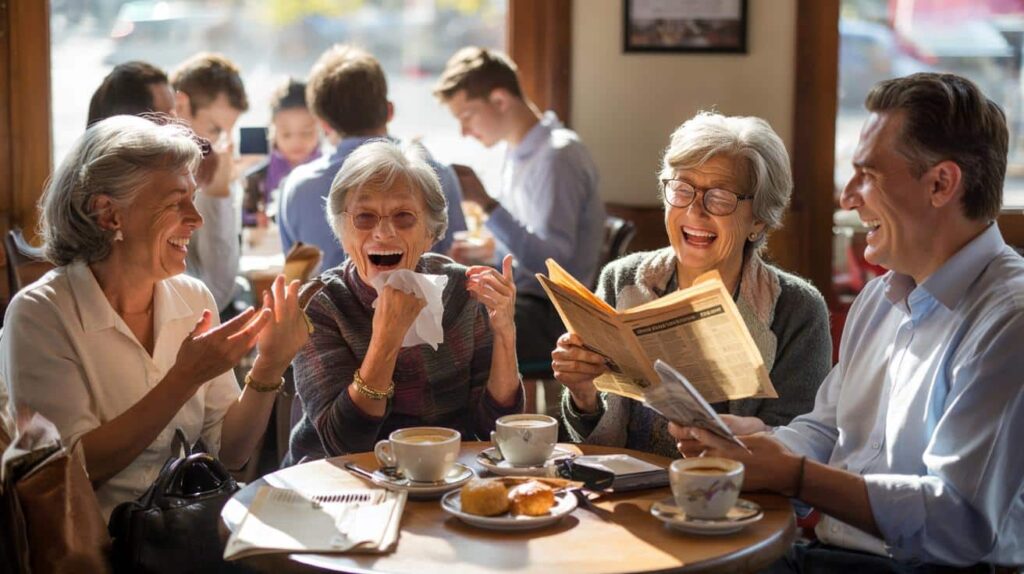
You can almost hear two different centuries humming in the same room.
One runs on notifications.
The other runs on rituals.

And watching them, you start to wonder: who, exactly, is winning this game of modern life?
1. Reading real newspapers and books, slowly
There’s something almost rebellious about a 70-year-old spreading out a crinkled newspaper on a park bench while the world rushes past with earbuds in. The pages rustle, the ink smudges slightly on their fingers, and time seems to stretch out around them. No infinite scroll, no autoplay video yelling in the background. Just headlines, columns, and the quiet pleasure of finishing an article from top to bottom.
You see the same thing with a worn paperback on the bus. A thumb slipped between the pages, the small satisfied gesture of closing the book after a chapter. It looks old-fashioned. It also looks strangely peaceful.
Ask people in their 60s and 70s why they cling to print and they rarely talk about nostalgia. They talk about focus. One retired nurse told me she reads the paper every morning at the same kitchen table where she used to pack school lunches. “Online, I lose the thread,” she said. “With the paper, I can actually think.”
There’s data behind that feeling. Some studies suggest we skim more and retain less on screens, because our brains expect distractions. A printed page, with its fixed layout and clear end, invites us to stay. To follow an argument. To remember who said what — and why it matters.
For older readers, that depth isn’t a luxury. It’s how they stay mentally sharp and emotionally grounded.
This slow reading habit also quietly protects their mood. Digital news feeds are built to be endless and alarming, always one swipe away from the next outrage. A newspaper is finite. A book has a last page. When you reach it, you’re done. You can put it down without guilt.
That boundary matters. It turns information from a flood into a river that can be crossed and left behind. It gives their day a rhythm: coffee, headlines, reflection, then movement. That tiny ritual, repeated for decades, becomes a kind of mental anchor in a world that’s permanently “updating”. And anchors are underrated.
2. Calling and visiting instead of just texting
People in their 60s and 70s are often quietly stubborn about this: they want to hear your voice. Or better yet, see your face. They’ll leave you voicemails that start with “It’s just me” and end with “Call when you’re free, no rush.” They still pop by with homemade soup. They arrange coffee “to catch up properly,” not a three-line DM.
It can feel old-school or even inconvenient to those of us juggling group chats and unread messages. Yet listen closely to a 20-minute phone call between two old friends, and you can almost feel the stress melting out of the line. Tone, pauses, laughter that overlaps. The human stuff text never quite holds.
One widower I spoke to, 74, has a weekly ritual: every Sunday at 5 p.m., he calls his childhood friend who lives three cities away. No agenda. They talk about their bad backs, good tomatoes, grandkids, and yesterday’s football match. “If I don’t hear his voice, the week feels unfinished,” he said.
Compare that with the modern “seen at 17:42, no reply” anxiety. Younger generations often live in constant micro-contact — hearts on stories, likes, quick replies — but struggle to feel genuinely heard. They’re rarely alone, but just as rarely deeply connected. Older people, protecting their phone-call and visit habits, end up with fewer interactions but richer ones. That difference adds up over years.
There’s also a simple emotional math at work. A call demands presence. You can’t half-listen the way you can half-skim a text between two apps. A visit requires even more: time, travel, some effort to look halfway decent and maybe bring something along. That investment signals care.
People in their 60s and 70s grew up before “typing…” bubbles existed. Their social world was built on voices, eye contact, and shared spaces. Keeping those habits now doesn’t just fight loneliness; it trains their brains to read feelings, not just words. And that, quietly, might explain why so many of them seem emotionally steadier than the hyper-connected but constantly lonely younger generations.
3. Cooking from scratch and sitting down to real meals
Watch an older person cook a “simple” dinner and you’ll see decades of muscle memory at work. Onion chopped almost without looking, pan heated before the oil, table set while the sauce simmers. They don’t think of it as mindful eating or a wellness trend. It’s just how they’ve always done it.
Meals aren’t content to consume while doomscrolling. They’re little daily ceremonies. The pot in the middle of the table. The extra plate “just in case”. The silence of the first bite, when everyone tastes before talking. *Food is not a background activity for them; it’s the main event for at least half an hour.*
A 68-year-old grandmother told me she still cooks almost every night, even when she’s alone. “I don’t want to forget how to feed myself properly,” she said, laughing. She sets a real plate, a cloth napkin, sometimes even a candle on dark winter evenings. Her grandkids think it’s “cute and old-timey” and then quietly devour everything.
Compare that with the glowing-laptop-on-the-couch dinner many younger adults know too well. Food eaten straight from the container, videos auto-playing, attention scattered. Quick, yes. But also strangely empty. The older habit of chopping, stirring, tasting, and sitting gives the day a clear before and after. A small arc of effort, reward, and rest.
Psychologists often point out that routines around meals support mental health: they anchor time, reduce decision fatigue, and encourage social connection. Generations who grew up with “be home by dinner” internalized this deeply. Let’s be honest: nobody really does this every single day. Yet people in their 60s and 70s come closer than most.
The tech-obsessed youth may have access to millions of recipes in their pocket, but many rarely practice the slow, repetitive acts that turn food into comfort and care. For older folks, these habits are not about nostalgia for “home-cooked goodness”. They’re quiet, daily proof that their bodies and lives deserve attention, not just efficiency.

4. Walking, puttering, and doing things the “long way”
If there is one old-school habit that silently protects happiness, it’s unhurried movement. People in their 60s and 70s walk to the bakery instead of ordering in. They putter in the garden. They take the stairs “for the exercise”, even if they’re slower now. It looks ordinary, almost trivial. It’s not.
That choice to move, rather than swipe or tap, creates dozens of micro-moments: a hello to the neighbor, a comment about the weather, a chance to notice the tree that’s finally blooming again. Their bodies may complain a bit. Their minds often thank them later.
Take the example of a 72-year-old man I met who refuses to buy a dishwasher. He washes plates by hand every evening after dinner, radio humming softly in the background. “Gives me time to think,” he shrugged. It’s ten, maybe fifteen minutes. Warm water, small repetitive motions, a clear start and finish.
Younger generations would automate this instantly if they could. Yet that “inefficient” chore is also a built-in decompressing ritual. The phone is in the other room. The mind wanders. Sometimes that’s when the day’s knot finally loosens, or when a stubborn problem quietly untangles in the back of the brain.
These long-way-around habits also protect older people from one sneaky trap of tech life: the illusion that convenience equals freedom. When everything is optimized, we move less, think less between tasks, and rarely get the mental white space where ideas and feelings actually surface.
By sticking to walks, small errands, physical chores, older generations keep dozens of sensory experiences in their day — smells, temperatures, sounds — that never make it through a screen. It’s not that they’re virtuous. Many simply never saw the point of changing what already worked. Yet this quiet resistance to constant optimization might be one reason they often sleep better, ruminate less, and feel their days as days, not just as a blur.
5. Keeping analog hobbies: knitting, fixing, collecting, tending
While a lot of younger people unwind by “just watching something”, older folks often go straight for their hands. Knitting, woodworking, stamp albums, model trains, houseplants, crosswords. They sit down, pick up their tools, and enter a tiny world where progress is visible and the rules don’t change every five minutes.
These activities are gloriously un-shareable. No algorithms, no likes. Just the small thrill of getting a seam right, coaxing a plant back to life, or finally finishing that stubborn puzzle you started three winters ago.
One 69-year-old former accountant showed me the notebooks where he tracks every tomato he has grown in his garden for the past 20 years. Weather, soil, taste rating, seed source. Yes, it’s nerdy. Yes, he knows an app could do it in two taps. But his pen has an ink stain where his fingers rest, and the pages curl at the corners from being read again and again.
Younger generations often dabble in hobbies, then abandon them when they don’t become side hustles or social media content. Older people, raised before everything had to be “monetized”, are comfortable doing things just because they like them. That low-pressure continuity — doing the same small satisfying thing for years — is a quiet happiness engine.
“People ask me what I ‘do’ with all the scarves I knit,” a 73-year-old woman told me. “I say: I enjoy making them. That’s the point. The scarves are just the excuse.”
- Old-school hobbies offer clear feedback: a finished object, a tidy drawer, a blooming plant.
- They slow the nervous system: repetitive, tactile actions calm racing thoughts.
- They build identity beyond work: you’re not just your job or your online persona.
- They connect generations: a recipe, a pattern, a tool passed down becomes a story.
- They resist the pressure to always be “on”: no notifications, no performance, just presence.
6. Holding on to daily rituals and weekly traditions
Ask someone in their seventies what day it is and they won’t check their phone. They’ll say, “Thursday — bridge night,” or “Sunday — roast at my daughter’s.” Their calendars are often structured around recurring human moments, not just work deadlines and notifications. That predictability might sound boring to a generation raised on spontaneity. It’s actually deeply soothing.
A cup of tea at the same hour. A TV show watched live, not streamed later. A weekly market visit. These rituals are quiet signposts, telling the brain: you’re here, time is moving, and you have a place in it.
We’ve all been there, that moment when every day blurs into the next, and you can’t remember if that memory was from last week or last month. Older people are not immune to that feeling, especially after retirement. Yet the ones who cling to small recurring traditions seem less adrift. A Friday coffee group at the senior center. A monthly book club. Lighting the same candle every evening before dinner in winter.
Younger generations often plan social time like a project, negotiating group chats, doodle polls, and last-minute cancellations. Older folks, by protecting their recurring slots, remove half the friction. “We always meet then” is strangely powerful. It stops life from being a random scroll of days.
These habits also leave less room for passive, lonely screen time to silently take over. When you know that Tuesday is choir night and Thursday you call your sister, the phone becomes a tool again, not a black hole. Their sense of continuity — “I’ve been doing this for years” — builds a quiet, sturdy form of happiness that doesn’t spike and crash like social media dopamine hits.
The tech-obsessed youth often chase novelty: new app, new series, new trend, new restaurant. People in their 60s and 70s, keeping their well-worn rituals, chase something else entirely: a life that feels lived, not just consumed.
What these “stubborn” habits are really protecting
When you zoom out, these six habits look less like resistance to progress and more like a subtle defense of three fragile things: attention, connection, and rhythm. Older generations are not anti-tech; many love video calls with grandkids or searching recipes online. They’re just more likely to treat technology as a guest, not as the landlord of their lives.
They keep one foot in the analog world where things take time, conversations have weight, and days have edges. That world is slower and sometimes messier. It’s also where meaning has room to breathe.
Younger, tech-immersed people may have more information, more entertainment, more options in their pocket than any generation before them. Yet many quietly admit they feel drained, scattered, and oddly alone. Sitting across from a 70-year-old who folds her newspaper, wipes her glasses, and asks, “So, how are you really?” can feel like stepping into a different climate.
The question isn’t whether we should all throw away our phones and buy landlines again. The real question is which of these old-school habits we secretly miss, and which we might dare to borrow back — slowly, imperfectly, one small ritual at a time.
| Key point | Detail | Value for the reader |
|---|---|---|
| Slow, analog attention | Print reading, hobbies, and offline rituals limit distractions and deepen focus. | Gives practical ideas to reclaim concentration in a noisy digital life. |
| Intentional connection | Calls, visits, and shared meals create fewer but richer interactions. | Offers alternatives to shallow online contact that often feels unsatisfying. |
| Stable daily rhythm | Repeated routines and traditions anchor time and reduce anxiety. | Helps readers design small, doable rituals that support emotional balance. |
FAQ:
- Do older people really use less tech, or do they just use it differently?Most use it selectively: they enjoy messaging, video calls, or online banking, but keep core habits analog, like reading print, meeting in person, and cooking. The difference is not absence of tech, but boundaries around it.
- Can younger adults realistically adopt these habits with busy schedules?Yes, on a small scale. One phone call a week, one cooked meal without screens, or ten pages of a paper book before bed already shifts how your day feels, without demanding a total lifestyle change.
- Do these old-school habits actually affect mental health?Many align with research-backed protective factors: regular routines, face-to-face contact, movement, and focused activities all correlate with lower stress and better mood over time.
- What if my friends aren’t into calls or in-person meetups?You can start by changing how you show up yourself: suggest a short call instead of a long text discussion, invite someone for a walk-and-talk, or start a recurring coffee with just one person who’s open to it.
- Is it too late to build these kinds of rituals if my life already feels chaotic?No. Rituals are built one small repeatable act at a time. Beginning with a five-minute daily habit — like a tech-free breakfast or an evening walk — is often more transformative than planning a complete overhaul.